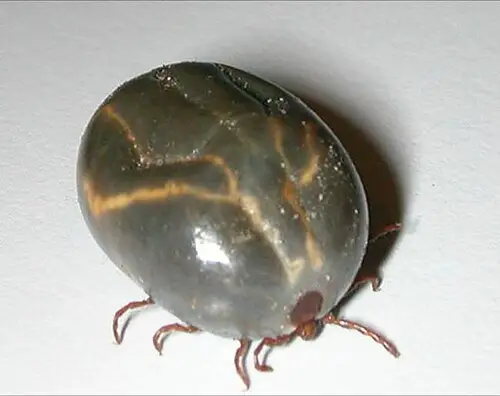
 📸 Photo
Photo: Commonsource · CC BY 3.0 · Wikimedia Commons Source
Asian longhorned tick
Haemaphysalis longicornis (Asian longhorned tick · フタトゲチマダニ)
Not Evaluated (NE) on the IUCN Red List yet.
💡 Everyday Comparisons for Size, Mass & Speed
- 💡 An unfed adult at 2.5–2.9 mm is similar in size to a sesame seed (Comparison).
- 💡 The Korea Disease Control and Prevention Agency advises not taking off clothes or lying down on grass, sitting on a mat instead, and showering after outdoor activities while checking the hair, around the ears, and behind the knees.
- 💡 If you find a hard tick attached to your body, the Korea Disease Control and Prevention Agency urges visiting a clinic rather than forcibly pulling it off.
Reference standards: coach bus ~12 m, mid-size car ~4.9 m, compact car ~1 t, basketball hoop 3.05 m, credit card 8.56 cm.
📖 1. Overview
The Asian longhorned tick is a grassland-dwelling hard tick and the most abundant tick vector of Severe Fever with Thrombocytopenia Syndrome (SFTS) in Korea. Because larvae, nymphs, and adults feed on blood from different hosts, it can transmit disease at every stage.
🦴 2. Anatomy & Morphology
Before feeding, adults are small at 2.5–2.9 mm in body length, swelling greatly once engorged with blood. Nymphs have eight legs and are about 2 mm long, while larvae have six legs.
🔍 3. Ecology & Behavior
Nymphs begin activity in spring (April–May), become adults and lay eggs in summer (June–July), and larvae grow in autumn (September–November), when numbers increase sharply. Because larvae, nymphs, and adults attach to different hosts to suck blood, they can transmit disease at all stages.
🇰🇷 4. Connection to Korea
According to the Korea Disease Control and Prevention Agency, it is the most common hard tick transmitting SFTS in Korea and lives mainly in grasslands. The agency advises preventive measures such as not lingering long in grass, wearing long sleeves and long pants, and using a mat.
📚 Sources & References
- • IUCN Red List: not evaluated (NE) — cross-checked with the Wikidata conservation-status entry
- • catalogueoflife.org — 3J7XJ
- • 국가생물종목록(국립생물자원관) ktsn 120000073681 — https://species.nibr.go.kr/home/mainHome.do?cont_link=009&subMenu=009002&contCd=009002&ktsn=120000073681
- • wikidata.org — Q3658534
- • commons.wikimedia.org — File:Haemaphysalis longicornis 1.jpg
- • extension.umd.edu — asian-longhorned-tick
- • kdca.go.kr — artclView.do
- • kdca.go.kr — download.do
- • ext.vt.edu — ENTO-560.pdf
- • extension.umaine.edu — ticks
- • Silhouette: PhyloPic — author not recorded · CC0 1.0 (Related taxon silhouette — Ixodes ricinus)
Recorded dimensions are widely cited representative estimates from public literature and may vary by study or specimen.