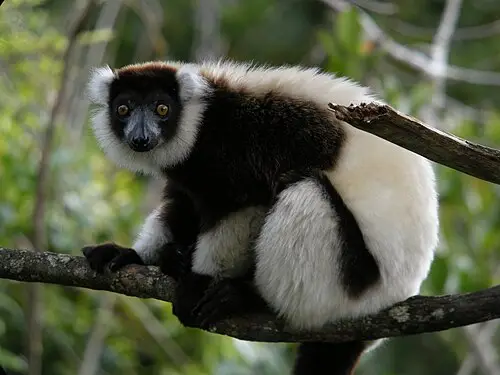
 📸 Photo
Photo: Frank Vassen · CC BY 2.0 · Wikimedia Commons Source
Black-and-white Ruffed Lemur
Varecia variegata (Black-and-white Ruffed Lemur · クロシロエリマキキツネザル)
💡 Everyday Comparisons for Size, Mass & Speed
- 💡 Its maximum weight of 4.8 kg is about two and a half 2 L bottles of water (Comparison).
- 💡 It can be seen in zoos and contributes to education and ecotourism, but is still sometimes hunted for food even where hunting is illegal (ADW, Economic Importance for Humans: Positive).
Reference standards: coach bus ~12 m, mid-size car ~4.9 m, compact car ~1 t, basketball hoop 3.05 m, credit card 8.56 cm.
Site-computed relative index from recorded values; not a formal scientific metric.
📖 1. Overview
The Black-and-white Ruffed Lemur lives in the eastern rainforests of Madagascar and is the largest species in the lemur family.
🦴 2. Anatomy & Morphology
Its long fur is a mix of black and white, with patterns varying slightly from individual to individual. Its hands, feet, face, and tail are black, while the crown of its head is white.
🔍 3. Ecology & Behavior
It is a fruit-loving lemur whose diet is 92% fruit, and when fruit is scarce it eats young leaves, flowers, and nectar. It usually lives in family groups of 2–5 individuals and has well-developed suspensory movements for hanging by its feet to pick fruit.
🇰🇷 4. Connection to Korea
No direct record connecting this species to Korea has been found.
📚 Sources & References
- • IUCN Red List CR (2020) — https://www.iucnredlist.org/species/22918/115574178
- • IUCN Red List category CR — latest assessment at iucnredlist.org
- • mammaldiversity.org — 1001011
- • iucnredlist.org — 115574178
- • wikidata.org — Q998074
- • commons.wikimedia.org — File:Black-and-White Ruffed Lemur, Mantadia, Madagascar.jpg
- • animaldiversity.org — Varecia variegata
- • nationalzoo.si.edu — black-and-white-ruffed-lemur
- • Silhouette: PhyloPic — Elise · CC0 1.0
Recorded dimensions are widely cited representative estimates from public literature and may vary by study or specimen.