 📸 Photo
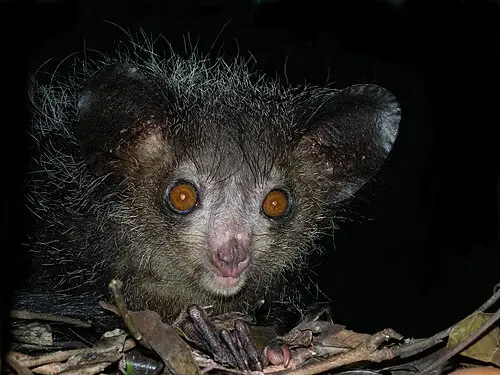
Photo: Frank Vassen from Brussels, Belgium · CC BY 2.0 · Wikimedia Commons Source
Aye-aye
Daubentonia madagascariensis (Aye-aye · アイアイ)
💡 Everyday Comparisons for Size, Mass & Speed
- 💡 Its daily calorie intake of about 240–342 kcal is around one bowl of cooked rice (about 300 kcal) (Comparison).
- 💡 Its favorite foods include breadfruit, bananas, and coconuts, and it also eats lychees and mangoes—fruits familiar in our grocery stores.
- 💡 Its maximum weight of 2.6 kg is about one and a half 2 L bottles of water (Comparison).
Reference standards: coach bus ~12 m, mid-size car ~4.9 m, compact car ~1 t, basketball hoop 3.05 m, credit card 8.56 cm.
Site-computed relative index from recorded values; not a formal scientific metric.
📖 1. Overview
The Aye-aye is a nocturnal primate living in Madagascar whose most distinctive feature is its long, slender middle finger.
🦴 2. Anatomy & Morphology
It has long, coarse dark brown or black fur with scattered white guard hairs, large triangular ears, and yellowish eyes. Its middle finger is thin, long, and flexible, and its incisors grow continuously.
🔍 3. Ecology & Behavior
It feeds on fruits, nuts, tree sap, and wood-boring insects, using its middle finger to pierce fruit rinds and scoop out the flesh. Active alone at night, it sleeps during the day in a round nest high in the trees.
🇰🇷 4. Connection to Korea
No direct record connecting this species to Korea has been found.
📚 Sources & References
- • IUCN Red List EN (2020) — https://www.iucnredlist.org/species/6302/115560793
- • IUCN Red List category EN — latest assessment at iucnredlist.org
- • mammaldiversity.org — 1000929
- • iucnredlist.org — 115560793
- • wikidata.org — Q186778
- • commons.wikimedia.org — File:Aye-aye (Daubentonia madagascariensis), Tsimbazaza Zoo,
- • animaldiversity.org — Daubentonia madagascariensis
- • Silhouette: PhyloPic — author not recorded · Public Domain Mark 1.0
Recorded dimensions are widely cited representative estimates from public literature and may vary by study or specimen.