 📸 Photo
Photo: Alex Dunkel ( Maky ) · CC BY 3.0 · Wikimedia Commons Source
Ring-tailed Lemur
Lemur catta (Ring-tailed Lemur · ワオキツネザル)
💡 Everyday Comparisons for Size, Mass & Speed
- 💡 It attracts ecotourism in southwestern Madagascar, helping the local economy.
- 💡 Males rub scent secretions onto their tails and wave them in 'stink fights.'
- 💡 Its maximum tail length of 63 cm is about the length of two 30 cm rulers placed end to end (Comparison).
Reference standards: coach bus ~12 m, mid-size car ~4.9 m, compact car ~1 t, basketball hoop 3.05 m, credit card 8.56 cm.
Site-computed relative index from recorded values; not a formal scientific metric.
📖 1. Overview
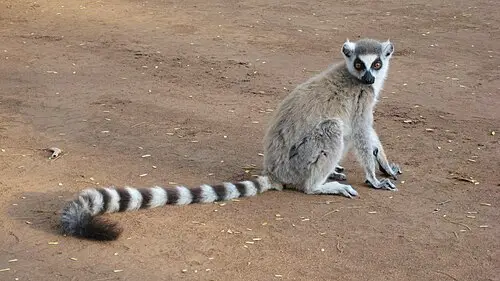
The Ring-tailed Lemur is a lemur living only in southern Madagascar, instantly recognizable by its black-and-white ringed tail.
🦴 2. Anatomy & Morphology
Alternating black and white rings run from the base to the tip of its tail, and its white face has black patches around the eyes and nose. It has scent glands.
🔍 3. Ecology & Behavior
It eats fruit (especially tamarind), leaves, flowers, insects, and small birds. In groups of 15–20 individuals, females outrank males.
🇰🇷 4. Connection to Korea
No direct record connecting this species to Korea has been found.
📚 Sources & References
- • IUCN Red List EN (2020) — https://www.iucnredlist.org/species/11496/115565760
- • IUCN Red List category EN — latest assessment at iucnredlist.org
- • mammaldiversity.org — 1001008
- • iucnredlist.org — 115565760
- • wikidata.org — Q185385
- • commons.wikimedia.org — File:Lemur catta 001.jpg
- • animaldiversity.org — Lemur catta
- • Silhouette: PhyloPic — Ferran Sayol · CC0 1.0
Recorded dimensions are widely cited representative estimates from public literature and may vary by study or specimen.