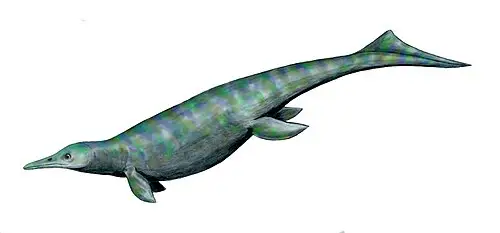
 🎨 Restoration
Restoration: Nobu Tamura ( http://spinops.blogspot.com ) · CC BY 2.5 · Wikimedia Commons Source
Life restorations are artistic reconstructions based on fossil evidence; true coloration and soft-tissue details remain uncertain.
Utatsusaurus
Utatsusaurus hataii (Utatsusaurus · ウタツサウルス)
Known only from fossils. The IUCN Red List assesses only species extant since 1500 CE, so fossil taxa are not assigned a category.
💡 Everyday Comparisons for Size, Mass & Speed
- 💡 Its body length of 3 m is about 2/3 the length of a passenger car (about 4.5 m) (Comparison).
- 💡 The ichthyosaur fossil site around Tatezaki in Utatsu, Miyagi Prefecture, where the fossils were found, is designated a Natural Monument in Japan and is introduced as possibly the oldest known ichthyosaur fossil site (Miyagi Prefecture cultural property guide).
Reference standards: coach bus ~12 m, mid-size car ~4.9 m, compact car ~1 t, basketball hoop 3.05 m, credit card 8.56 cm.
📖 1. Overview
Utatsusaurus hataii (genus Utatsusaurus) was an early ichthyosaur (fish-shaped marine reptile) that lived in the sea during the Early Triassic about two hundred and 50 million years ago. It was named after Utatsu (now Minamisanriku Town) in Miyagi Prefecture, Japan, where it was first discovered.
🦴 2. Anatomy & Morphology
Papers describe it as having a slender body 2–3 m long and an eel-like tail fin.
🔍 3. Fossil Record & Paleoecology
A study examining the internal microstructure of its ribs and limb bones interpreted it as an active open-ocean swimmer. That study used bones from two individuals found in the Osawa Formation of Miyagi Prefecture.
🇰🇷 4. Connection to Korea
No direct record connecting this species to Korea has been found.
📚 Sources & References
- • Fossil taxon — the IUCN Red List assesses only species living or extinct since 1500
- • paleobiodb.org — basicTaxonInfo
- • wikidata.org — Q3053716
- • commons.wikimedia.org — File:Utatsusaurus BW.jpg
- • app.pan.pl — app20120045.pdf
- • pref.miyagi.jp — 27utatu.html
- • Silhouette: PhyloPic — Will Toosey · CC BY 4.0
Recorded dimensions are widely cited representative estimates from public literature and may vary by study or specimen.