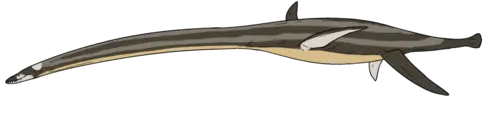
 🎨 Restoration
Restoration: Connor Ashbridge · CC BY-SA 4.0 · Wikimedia Commons Source
Life restorations are artistic reconstructions based on fossil evidence; true coloration and soft-tissue details remain uncertain.
Futabasaurus
Futabasaurus suzukii (Futabasaurus · フタバスズキリュウ)
Known only from fossils. The IUCN Red List assesses only species extant since 1500 CE, so fossil taxa are not assigned a category.
💡 Everyday Comparisons for Size, Mass & Speed
- 💡 An estimated maximum body length of 9 m is about 3/4 of the length of a large express bus (about 12 m) (Comparison).
- 💡 Found in the Tamayama Formation of the Futaba Group (Late Cretaceous) in Fukushima Prefecture, Japan, its scientific name Futabasaurus directly incorporates the name of the formation, "Futaba."
Reference standards: coach bus ~12 m, mid-size car ~4.9 m, compact car ~1 t, basketball hoop 3.05 m, credit card 8.56 cm.
📖 1. Overview
Futabasaurus suzukii (genus Futabasaurus) was a long-necked plesiosaur (family Elasmosauridae) that lived in the seas of Japan during the Santonian stage of the Late Cretaceous. First discovered by a high school student in Iwaki, Fukushima Prefecture, in 1968, it was given a scientific name as a new genus and species in 2006.
🦴 2. Anatomy & Morphology
Parts of the skull, the lower jaw, vertebrae from the rear neck to the sacrum, ribs, shoulder and pelvic bones, and bones of all four limbs remain, and most were found articulated.
🔍 3. Fossil Record & Paleoecology
The paper notes that some bones bear marks of being bitten or scavenged by sharks. Researchers at the National Museum of Nature and Science published it as a new genus and species in the journal Palaeontology in 2006.
🇰🇷 4. Connection to Korea
No direct record connecting this species to Korea has been found.
📚 Sources & References
- • Fossil taxon — the IUCN Red List assesses only species living or extinct since 1500
- • paleobiodb.org — basicTaxonInfo
- • wikidata.org — Q20718088
- • commons.wikimedia.org — File:National Museum of Nature and Science- Futabasaurus.jpg
- • kahaku.go.jp — 05hutaba
- • palass.org — article pp467-484
- • Silhouette: PhyloPic — Chris Forbes · CC BY 4.0 (Related taxon silhouette — Elasmosauridae)
Recorded dimensions are widely cited representative estimates from public literature and may vary by study or specimen.