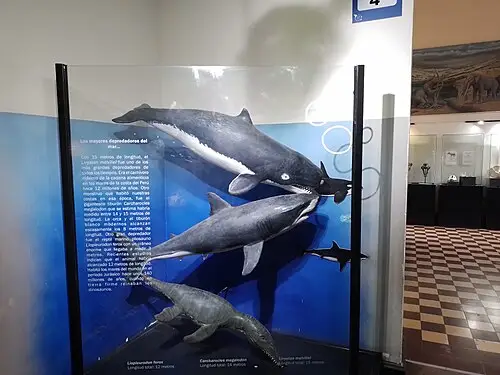
 🎨 Restoration
Restoration: Suki3464 · CC BY-SA 4.0 · Wikimedia Commons Source
Life restorations are artistic reconstructions based on fossil evidence; true coloration and soft-tissue details remain uncertain.
Liopleurodon
Liopleurodon ferox (Liopleurodon · Liopleurodon)
Known only from fossils. The IUCN Red List assesses only species extant since 1500 CE, so fossil taxa are not assigned a category.
💡 Everyday Comparisons for Size, Mass & Speed
- 💡 A maximum length of just over 8 m is slightly short of the length of two passenger cars (about 4.5 m each) (Comparison).
- 💡 A university press release reported that a 2026 University of Portsmouth study corrected the decades-old claim of 18–25 m as an exaggeration.
Reference standards: coach bus ~12 m, mid-size car ~4.9 m, compact car ~1 t, basketball hoop 3.05 m, credit card 8.56 cm.
📖 1. Overview
Liopleurodon ferox (genus Liopleurodon) was a pliosaurian marine reptile that served as an apex predator in Middle Jurassic seas. It was first described from a single tooth found near Boulogne-sur-Mer in northern France.
🦴 2. Anatomy & Morphology
A 2026 study finds that its skull length was about 1/4 of its total body length, a larger proportion than the previously known 1/5.
🔍 3. Fossil Record & Paleoecology
It has been studied from specimens in the Oxford Clay Formation of the United Kingdom (around the Peterborough brick pits). Because the formerly cited size of 18–25 m was based on large fragmentary fossils that cannot be confirmed as belonging to this genus, recent studies have reduced its maximum length to just over 8 m.
🇰🇷 4. Connection to Korea
No direct record connecting this species to Korea has been found.
📚 Sources & References
- • Fossil taxon — the IUCN Red List assesses only species living or extinct since 1500
- • paleobiodb.org — basicTaxonInfo
- • wikidata.org — Q1130273
- • port.ac.uk — jurassic-sea-monster-was-smaller-than-once-thought-but-no-le
- • doi.org — 02724634.2026.2691149
- • Silhouette: PhyloPic — Caleb M. Gordon · CC0 1.0
Recorded dimensions are widely cited representative estimates from public literature and may vary by study or specimen.