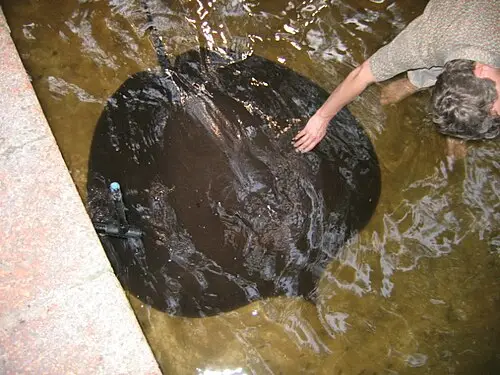
 📸 Photo
Photo: Barry Rogge · CC BY 2.0 · Wikimedia Commons Source
Giant freshwater whipray
Urogymnus polylepis (Giant freshwater whipray · Giant freshwater whipray)
💡 Everyday Comparisons for Size, Mass & Speed
- 💡 Its maximum disc width of 2.4 m is longer than the length of a bed (about 2 m) (Comparison).
- 💡 Its maximum weight of 600 kg is the weight of 30 bags of 20 kg rice (Comparison).
- 💡 Its meat is sold fresh in markets, with large individuals cut into pieces and sold by the kilogram (FishBase).
Reference standards: coach bus ~12 m, mid-size car ~4.9 m, compact car ~1 t, basketball hoop 3.05 m, credit card 8.56 cm.
Site-computed relative index from recorded values; not a formal scientific metric.
📖 1. Overview
The giant freshwater whipray is a huge freshwater stingray living on sandy bottoms of estuaries and large rivers, threatened by overfishing and pollution.
🦴 2. Anatomy & Morphology
It is a large stingray with a reported maximum disc width of up to 2.4 m. It lives flat against sandy bottoms of rivers and estuaries.
🔍 3. Ecology & Behavior
It feeds on bottom-dwelling invertebrates and fish. It is ovoviviparous, hatching its young inside the mother before giving birth.
🇰🇷 4. Connection to Korea
No direct record connecting this species to Korea has been found.
📚 Sources & References
- • IUCN Red List EN (2021) — https://www.iucnredlist.org/species/195320/104294071
- • IUCN Red List category EN — latest assessment at iucnredlist.org
- • catalogueoflife.org — 7DV7D
- • iucnredlist.org — 104294071
- • wikidata.org — Q46608149
- • commons.wikimedia.org — File:Himantura polylepis.jpg
- • fishbase.se — Urogymnus-polylepis.html
- • Silhouette: PhyloPic — M Kolmann · CC0 1.0
Recorded dimensions are widely cited representative estimates from public literature and may vary by study or specimen.