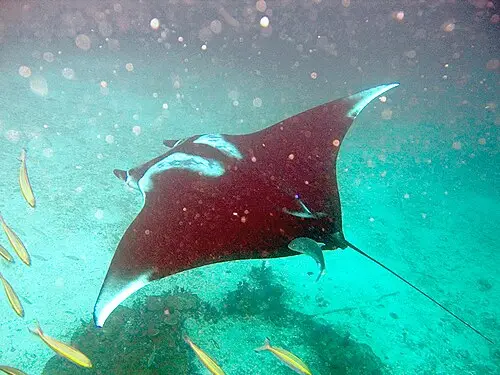
 📸 Photo
Photo: jon hanson from london, UK · CC BY-SA 2.0 · Wikimedia Commons Source
Oceanic manta ray
Mobula birostris (Oceanic manta ray · オニイトマキエイ)
💡 Everyday Comparisons for Size, Mass & Speed
- 💡 Its disc width of 9.1 m is just short of the length of a city bus (about 10–12 m) (Comparison).
- 💡 Its weight of 3 tons is about the weight of two passenger cars (about 1.5 tons each) (Comparison).
- 💡 A newborn pup's width of 122–127 cm is about 3/4 of an adult human's height (about 1.7 m) (Comparison).
Reference standards: coach bus ~12 m, mid-size car ~4.9 m, compact car ~1 t, basketball hoop 3.05 m, credit card 8.56 cm.
Site-computed relative index from recorded values; not a formal scientific metric.
📖 1. Overview
The oceanic manta ray is a ray over 9 m in disc width living in tropical to temperate waters worldwide. It is assessed as Endangered (EN, 2022) on the IUCN Red List.
🦴 2. Anatomy & Morphology
It has been recorded at a maximum disc width of 9.1 m and a maximum weight of 3 tons. Pups are born at a width of 122–127 cm.
🔍 3. Ecology & Behavior
It mainly filter-feeds on plankton and also eats small to medium-sized fish. It is ovoviviparous, giving birth to up to 2 young at a time.
🇰🇷 4. Connection to Korea
No direct record connecting this species to Korea has been found.
📚 Sources & References
- • IUCN Red List EN (2022) — https://www.iucnredlist.org/species/198921/214397182
- • IUCN Red List category EN — latest assessment at iucnredlist.org
- • catalogueoflife.org — 73N5T
- • iucnredlist.org — 214397182
- • wikidata.org — Q321976
- • commons.wikimedia.org — File:Manta birostris-Thailand3.jpg
- • fishbase.se — Mobula-birostris.html
- • Silhouette: PhyloPic — author not recorded · CC0 1.0
Recorded dimensions are widely cited representative estimates from public literature and may vary by study or specimen.