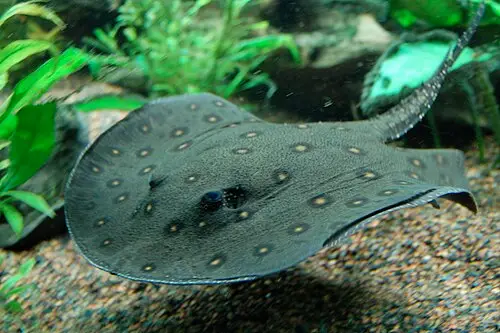
 📸 Photo
Photo: Steven G. Johnson · CC BY-SA 3.0 · Wikimedia Commons Source
South American freshwater stingray
Potamotrygon motoro (South American freshwater stingray · ポタモトリゴン・モトロ)
💡 Everyday Comparisons for Size, Mass & Speed
- 💡 Its maximum length of 1 m is the same length as a 1 m ruler (Comparison).
- 💡 Its maximum weight of 15 kg is three-quarters (3/4) of a 20 kg bag of rice (Comparison).
- 💡 Juveniles are popular as aquarium fish and commonly seen in the ornamental fish trade, while in the Paraná–La Plata basin they are also regularly eaten (Animal Diversity Web).
Reference standards: coach bus ~12 m, mid-size car ~4.9 m, compact car ~1 t, basketball hoop 3.05 m, credit card 8.56 cm.
Site-computed relative index from recorded values; not a formal scientific metric.
📖 1. Overview
The South American freshwater stingray is a freshwater ray living in tropical rivers of South America that spends its time half-buried in calm sandy bottoms.
🦴 2. Anatomy & Morphology
The body is oval with black-ringed orange-to-yellow eyespots on a grayish-brown back, and its sturdy tail bears a venomous spine. Females are slightly larger than males.
🔍 3. Ecology & Behavior
Newborn pups eat plankton, juveniles eat small mollusks, crustaceans, and insect larvae, and adults eat fish, shrimp, snails, and aquatic insects. In captivity, a single female has been recorded giving birth to 16 pups.
🇰🇷 4. Connection to Korea
No direct record connecting this species to Korea has been found.
📚 Sources & References
- • IUCN Red List LC (2025) — https://www.iucnredlist.org/species/39404/2923869
- • IUCN Red List category LC — latest assessment at iucnredlist.org
- • catalogueoflife.org — 4M4R9
- • iucnredlist.org — 2923869
- • wikidata.org — Q1297913
- • commons.wikimedia.org — File:Ocellate river stingray, Boston Aquarium.jpg
- • animaldiversity.org — Potamotrygon motoro
- • fishbase.se — Potamotrygon-motoro.html
- • Silhouette: PhyloPic — M Kolmann · CC0 1.0
Recorded dimensions are widely cited representative estimates from public literature and may vary by study or specimen.