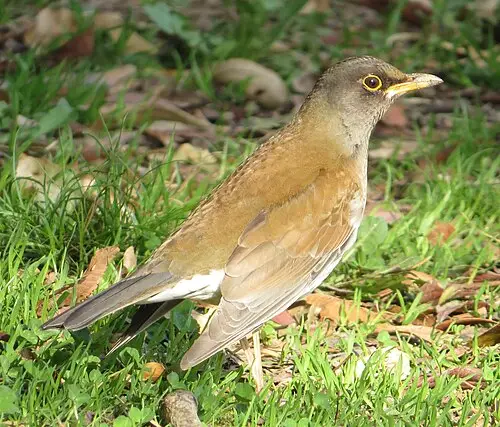
 📸 Photo
Photo: Alpsdake · CC BY-SA 3.0 · Wikimedia Commons Source
Pale Thrush
Turdus pallidus (Pale Thrush · シロハラ)
💡 Everyday Comparisons for Size, Mass & Speed
- 💡 Its body length of 23 cm is slightly taller than a 500 mL plastic bottle (about 20 cm) (Comparison).
- 💡 According to the National List of Species of Korea, it passes through the entire Korean Peninsula in spring and autumn, so it can be encountered along forest edges when the seasons change.
Reference standards: coach bus ~12 m, mid-size car ~4.9 m, compact car ~1 t, basketball hoop 3.05 m, credit card 8.56 cm.
📖 1. Overview
The Pale Thrush is a bird in the thrush family (order Passeriformes) that breeds in Primorye and on the Korean Peninsula and winters in southern China and Japan. Its Korean name comes from the white center of its belly.
🦴 2. Anatomy & Morphology
Its body length is about 23 cm. In winter plumage, the male has an olive-tinged slate-gray crown, gray cheeks and throat, pale pinkish-brown flanks, brown irises, and yellow legs.
🔍 3. Ecology & Behavior
It breeds in forests, building its nest on tree branches not very high above the ground. It lays 4–5 eggs around June and feeds on seeds, insects, spiders, and myriapods.
🇰🇷 4. Connection to Korea
The National List of Species of Korea records it as a common summer visitor in Korea, an uncommon resident in southern regions, and a passage migrant passing across the Korean Peninsula in spring and autumn.
📚 Sources & References
- • IUCN Red List LC (2024) — https://www.iucnredlist.org/species/22708797/264266841
- • IUCN Red List category LC — latest assessment at iucnredlist.org
- • doi.org — avilist.v2026
- • iucnredlist.org — 264266841
- • 국가생물종목록(국립생물자원관) ktsn 120000002098 — https://species.nibr.go.kr/home/mainHome.do?cont_link=009&subMenu=009002&contCd=009002&ktsn=120000002098
- • wikidata.org — Q1589031
- • commons.wikimedia.org — File:Turdus pallidus.JPG
- • species.nibr.go.kr — mainHome.do
- • Silhouette: PhyloPic — Anthony Caravaggi · CC0 1.0 (Congeneric silhouette — Turdus merula)
Recorded dimensions are widely cited representative estimates from public literature and may vary by study or specimen.