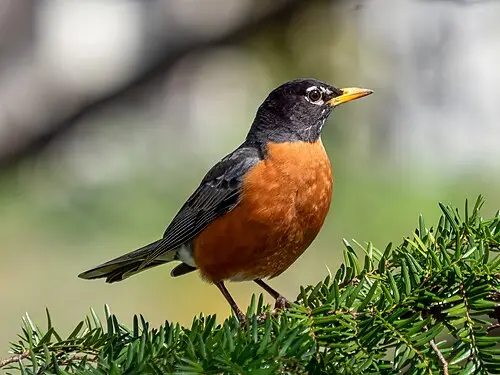
 📸 Photo
Photo: Rhododendrites · CC BY-SA 4.0 · Wikimedia Commons Source
American Robin
Turdus migratorius (American Robin · コマツグミ)
💡 Everyday Comparisons for Size, Mass & Speed
- 💡 Its weight of 77 g is similar to the weight of 3 AA batteries (Comparison; the Smithsonian National Zoo uses the same comparison).
- 💡 According to the Smithsonian National Zoo, it is very common in parks, backyards, and cities, and ADW notes that it helps control insects such as beetles that damage gardens and crops.
Reference standards: coach bus ~12 m, mid-size car ~4.9 m, compact car ~1 t, basketball hoop 3.05 m, credit card 8.56 cm.
Site-computed relative index from recorded values; not a formal scientific metric.
📖 1. Overview
The American Robin is the most widespread thrush in North America, living close to people from forest edges to parks, backyards, and cities. Its back is brown and its breast is reddish-brown.
🦴 2. Anatomy & Morphology
It has a blackish-gray head, gray back and wings, bright reddish-brown underparts, and a white patch under the tail. There are white crescent markings above and below the eyes, and the white throat is streaked with black.
🔍 3. Ecology & Behavior
Early on spring and summer mornings it hops and runs across lawns in search of earthworms and insects, while in winter it eats mainly fruits. Its diet is roughly 40% invertebrates and 60% fruits and berries.
🇰🇷 4. Connection to Korea
No direct record connecting this species to Korea has been found.
📚 Sources & References
- • IUCN Red List LC (2021) — https://www.iucnredlist.org/species/103889499/139392811
- • IUCN Red List category LC — latest assessment at iucnredlist.org
- • doi.org — avilist.v2026
- • iucnredlist.org — 139392811
- • wikidata.org — Q460967
- • commons.wikimedia.org — File:American robin (71307).jpg
- • animaldiversity.org — Turdus migratorius
- • nationalzoo.si.edu — american-robin
- • Silhouette: PhyloPic — Andy Wilson · CC0 1.0
Recorded dimensions are widely cited representative estimates from public literature and may vary by study or specimen.