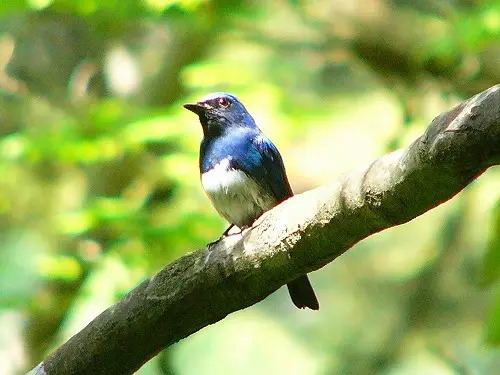
 📸 Photo
Photo: Flickr user arudhio . Photo uploaded to commons by user ltshears · CC BY-SA 2.0 · Wikimedia Commons Source
Blue-and-white Flycatcher
Cyanoptila cyanomelana (Blue-and-white Flycatcher · オオルリ)
💡 Everyday Comparisons for Size, Mass & Speed
- 💡 Its body length of 16.5 cm is slightly longer than a smartphone (about 15 cm) (Comparison).
- 💡 According to the National List of Species of Korea, because it is a summer visitor breeding nationwide, males can be heard singing from high branches in valley deciduous broadleaf forests from May to July (months 5–7).
Reference standards: coach bus ~12 m, mid-size car ~4.9 m, compact car ~1 t, basketball hoop 3.05 m, credit card 8.56 cm.
📖 1. Overview
The blue-and-white flycatcher is a summer visitor frequently seen across Korea, with males standing out for their glossy blue plumage. It spends the winter in Indochina, Indonesia, and Borneo.
🦴 2. Anatomy & Morphology
Its body length is 16.5 cm. Males are glossy blue from the forehead and crown to the back, with a black face, breast, and flanks and a white belly, whereas females have a pale greenish-brown back.
🔍 3. Ecology & Behavior
It builds a nest of moss and fallen leaves on rocks or cliffs near valleys and lays 3–5 whitish eggs in May–July (months 5–7). Males sing a clear 'ppii-ppippi jjeureureureureu jiit' song from conspicuous treetops.
🇰🇷 4. Connection to Korea
The National List of Species of Korea describes it as a summer visitor that commonly breeds across Korea.
📚 Sources & References
- • IUCN Red List LC (2024) — https://www.iucnredlist.org/species/103758039/264251020
- • IUCN Red List category LC — latest assessment at iucnredlist.org
- • doi.org — avilist.v2026
- • iucnredlist.org — 264251020
- • 국가생물종목록(국립생물자원관) ktsn 120000002145 — https://species.nibr.go.kr/home/mainHome.do?cont_link=009&subMenu=009002&contCd=009002&ktsn=120000002145
- • wikidata.org — Q73477
- • commons.wikimedia.org — File:Blue-and-white Flycatcher.jpg
- • species.nibr.go.kr — mainHome.do
- • Silhouette: PhyloPic — Martin Bulla, based on François Desbordes' illustration · CC BY 4.0 (Related taxon silhouette — Phoenicurus ochruros)
Recorded dimensions are widely cited representative estimates from public literature and may vary by study or specimen.