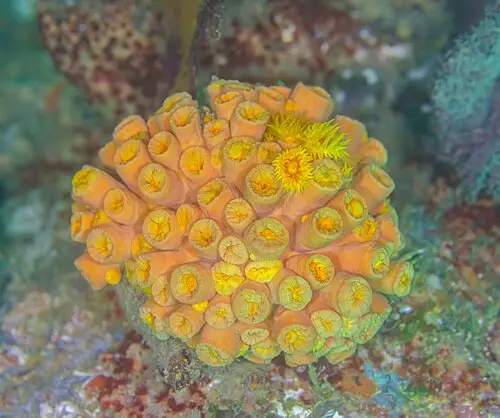
 📸 Photo
Photo: Diego Delso · CC BY-SA 4.0 · Wikimedia Commons Source
Orange cup coral
Tubastraea coccinea (Orange cup coral · イボヤギ)
Not Evaluated (NE) on the IUCN Red List yet.
🇰🇷 Class II endangered wildlife (Korea)
💡 Everyday Comparisons for Size, Mass & Speed
- 💡 Its colony height of 6.3 cm is about 1/3 of the short side of an A4 sheet of paper (21 cm) (Comparison).
- 💡 Because unauthorized collection for ornamental purposes threatens this coral, scuba divers in Jeju waters must not collect or touch it (threat factor cited by the National Institute of Ecology).
Reference standards: coach bus ~12 m, mid-size car ~4.9 m, compact car ~1 t, basketball hoop 3.05 m, credit card 8.56 cm.
📖 1. Overview
The orange cup coral is a small vermilion stony coral living attached to rocky reef slopes in Jeju waters, and in Korea it is a Class II endangered wildlife (Korea) species.
🦴 2. Anatomy & Morphology
Its colony is tree-shaped, about 5.5–6.3 cm high, and entirely vermilion, with pale orange or red tentacles emerging from each calcareous cup-shaped corallite.
🔍 3. Ecology & Behavior
It keeps its tentacles retracted during the day and extends them at night to catch zooplankton, reproducing either by budding or sexually depending on the environment.
🇰🇷 4. Connection to Korea
It is a Class II endangered wildlife (Korea) species distributed in Jeju Island waters in Korea, and unauthorized collection for ornamental use is cited as the main threat factor.
📚 Sources & References
- • 멸종위기 야생생물 Ⅱ급 — 국가생물종목록(국립생물자원관) ktsn 120000039877 — https://species.nibr.go.kr/home/mainHome.do?cont_link=009&subMenu=009002&contCd=009002&ktsn=120000039877
- • IUCN Red List: not evaluated (NE) — cross-checked with the Wikidata conservation-status entry
- • Korean protection status: Class II endangered wildlife (Korea)
- • marinespecies.org — aphia.php
- • 국가생물종목록(국립생물자원관) ktsn 120000039877 — https://species.nibr.go.kr/home/mainHome.do?cont_link=009&subMenu=009002&contCd=009002&ktsn=120000039877
- • wikidata.org — Q3940718
- • commons.wikimedia.org — File:Coral sol (Tubastraea coccinea), Cabo Pulmo, Baja Calif
- • nie.re.kr — view.do
- • nie.re.kr — list.do
Recorded dimensions are widely cited representative estimates from public literature and may vary by study or specimen.