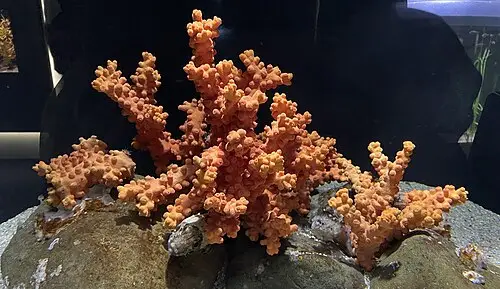
 📸 Photo
Photo: Totti · CC BY-SA 4.0 · Wikimedia Commons Source
Dendrophyllia cribrosa
Dendrophyllia cribrosa (Dendrophyllia cribrosa · Dendrophyllia cribrosa)
Not Evaluated (NE) on the IUCN Red List yet.
🇰🇷 Class II endangered wildlife (Korea)
💡 Everyday Comparisons for Size, Mass & Speed
- 💡 The height of the largest colonies, about 30 cm, is almost equal to the long side of an A4 sheet of paper (29.7 cm) (Comparison).
- 💡 Discarded or broken fishing ropes and derelict fishing gear are cited as major threats damaging this coral, linking its conservation to the issue of marine ghost gear (National Institute of Ecology).
Reference standards: coach bus ~12 m, mid-size car ~4.9 m, compact car ~1 t, basketball hoop 3.05 m, credit card 8.56 cm.
📖 1. Overview
Dendrophyllia cribrosa is an orange tree-shaped stony coral living rarely in deep water (around 100 m depth), and is designated as Class II endangered wildlife (Korea).
🦴 2. Anatomy & Morphology
The largest colonies are tree-shaped, about 30 cm tall and 45 cm wide, with cylindrical branches, distinct costae (vertical ridges), and porous grooves between the ridges.
🔍 3. Ecology & Behavior
It captures plankton with its tentacles, reproduces by budding or sexual reproduction depending on the environment, and hosts many organisms in and on its colony, making it important in the ecosystem.
🇰🇷 4. Connection to Korea
Designated as Class II endangered wildlife (Korea), it is distributed mainly along the South Sea and East Sea coasts, where damage from fishing ropes and derelict fishing gear and indiscriminate collection are major threats.
📚 Sources & References
- • 멸종위기 야생생물 Ⅱ급 — 국가생물종목록(국립생물자원관) ktsn 120000039874 — https://species.nibr.go.kr/home/mainHome.do?cont_link=009&subMenu=009002&contCd=009002&ktsn=120000039874
- • IUCN Red List: not evaluated (NE) — cross-checked with the Wikidata conservation-status entry
- • Korean protection status: Class II endangered wildlife (Korea)
- • marinespecies.org — aphia.php
- • 국가생물종목록(국립생물자원관) ktsn 120000039874 — https://species.nibr.go.kr/home/mainHome.do?cont_link=009&subMenu=009002&contCd=009002&ktsn=120000039874
- • wikidata.org — Q3950975
- • commons.wikimedia.org — File:Dendrophyllia cribrosa Shikoku.jpg
- • nie.re.kr — view.do
- • nie.re.kr — list.do
Recorded dimensions are widely cited representative estimates from public literature and may vary by study or specimen.