 📸 Photo
Photo: Public domain · Public domain · Wikimedia Commons Source
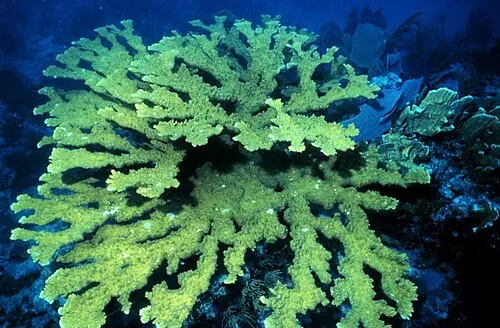
Elkhorn coral
Acropora palmata (Elkhorn coral · エルクホーンサンゴ)
💡 Everyday Comparisons for Size, Mass & Speed
- 💡 A colony diameter of 12 feet (about 3.7 m) is slightly shorter than a passenger car (about 4.5 m) (Comparison).
- 💡 Colonies grown into dense thickets provide shelter for fish and protect coastlines from large waves and storms (NOAA).
- 💡 Healthy coral reefs form the foundation for Caribbean ecotourism and the tropical fish trade (ADW).
Reference standards: coach bus ~12 m, mid-size car ~4.9 m, compact car ~1 t, basketball hoop 3.05 m, credit card 8.56 cm.
📖 1. Overview
Elkhorn coral is a coral that grows antler-like branches on shallow coral reefs of the Caribbean. It was assessed as Critically Endangered (CR, 2022) on the IUCN Red List.
🦴 2. Anatomy & Morphology
Colonies are golden-brown with white branch tips, and flattened to rounded branches angle upward from a central trunk. Branches are up to 15 inches (about 38 cm) wide and 1–2 inches thick.
🔍 3. Ecology & Behavior
It obtains energy from sugars produced by symbiotic algae living inside its tissues, and at night it also captures plankton with its polyp tentacles. Its main mode of reproduction is fragmentation, where broken branches reattach and grow into new colonies.
🇰🇷 4. Connection to Korea
No direct record connecting this species to Korea has been found.
📚 Sources & References
- • IUCN Red List CR (2022) — https://www.iucnredlist.org/species/133006/165672016
- • IUCN Red List category CR — latest assessment at iucnredlist.org
- • marinespecies.org — aphia.php
- • iucnredlist.org — 165672016
- • wikidata.org — Q163614
- • commons.wikimedia.org — File:Elkhorn coral.jpg
- • fisheries.noaa.gov — elkhorn-coral
- • animaldiversity.org — Acropora palmata
- • sealifebase.se — Acropora-palmata.html
- • Silhouette: PhyloPic — Victor Piñon-González · CC0 1.0
Recorded dimensions are widely cited representative estimates from public literature and may vary by study or specimen.