 📸 Photo
Photo: L0k1m0nk33 at English Wikipedia · CC BY-SA 3.0 · Wikimedia Commons Source
Greater Kudu
Tragelaphus strepsiceros (Greater Kudu · クーズー)
💡 Everyday Comparisons for Size, Mass & Speed
- 💡 In southern Africa, it has long been hunted for its meat and the male's horns have been prized as hunting trophies (Animal Diversity Web).
- 💡 A horn length of 120 cm is longer than a 1 m ruler (Comparison).
- 💡 It can be seen in zoos around the world (Animal Diversity Web).
Reference standards: coach bus ~12 m, mid-size car ~4.9 m, compact car ~1 t, basketball hoop 3.05 m, credit card 8.56 cm.
Site-computed relative index from recorded values; not a formal scientific metric.
📖 1. Overview
The Greater Kudu is one of the tallest antelopes and lives in brushy woodlands and along riverbanks.
🦴 2. Anatomy & Morphology
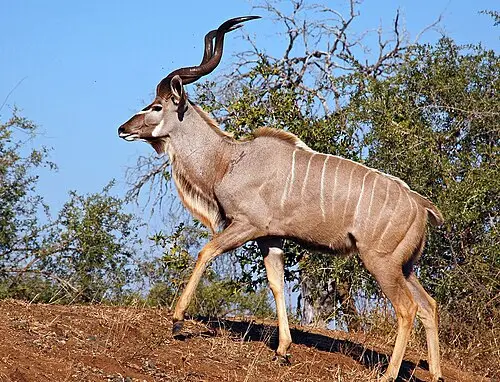
Males have the largest horns in their group, averaging up to 120 cm. Body color ranges from reddish brown to bluish gray with 6–10 stripes on the back, and males have a beard.
🔍 3. Ecology & Behavior
It is an herbivore that eats leaves, herbs, fruits, vines, flowers, and some new grass. Females live in groups of 1–3 with their young while males live separately in bachelor herds of 2–10, and the gestation period is 9 months.
🇰🇷 4. Connection to Korea
No direct record connecting this species to Korea has been found.
📚 Sources & References
- • IUCN Red List LC (2020) — https://www.iucnredlist.org/species/22054/166487759
- • IUCN Red List category LC — latest assessment at iucnredlist.org
- • mammaldiversity.org — 1006283
- • iucnredlist.org — 166487759
- • wikidata.org — Q139487
- • commons.wikimedia.org — File:Male greater kudu.jpg
- • animaldiversity.org — Tragelaphus strepsiceros
- • Silhouette: PhyloPic — Robert Hering · CC BY 3.0
Recorded dimensions are widely cited representative estimates from public literature and may vary by study or specimen.