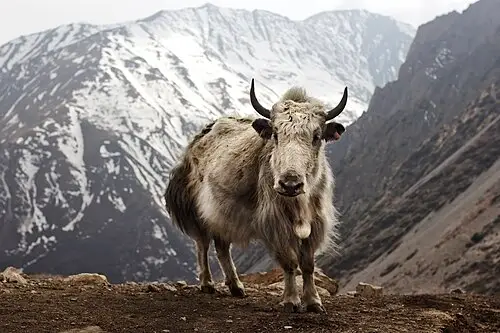
 📸 Photo
Photo: travelwayoflife · CC BY-SA 2.0 · Wikimedia Commons Source
Domestic Yak
Bos grunniens (Domestic Yak · ヤク)
Not Evaluated (NE) on the IUCN Red List yet.
💡 Everyday Comparisons for Size, Mass & Speed
- 💡 On the Tibetan Plateau, domestic yaks carry loads, while the soft hair of calves is made into clothing and the coarse hair of adults into blankets and tents (Animal Diversity Web).
- 💡 Where firewood is scarce, yak dung is burned as fuel, and yak milk is made into butter and cheese for export (Animal Diversity Web).
- 💡 The maximum wild male length of 3.25 m is about 72 percent of the length of a passenger car (about 4.5 m) (Comparison).
Reference standards: coach bus ~12 m, mid-size car ~4.9 m, compact car ~1 t, basketball hoop 3.05 m, credit card 8.56 cm.
Site-computed relative index from recorded values; not a formal scientific metric.
📖 1. Overview
The domestic yak belongs to a cattle group living on the cold, high grasslands of the Tibetan Plateau, where many are kept by humans. Wild males can exceed 3 m in body length.
🦴 2. Anatomy & Morphology
Long blackish-brown hair covers the body all the way to the tail, and its large black horns curve upward. Domestic yaks have shorter legs, broader hooves, and weaker horns that are sometimes absent.
🔍 3. Ecology & Behavior
Active mainly during the day, it grazes on grasses, mosses, and lichens, migrating long distances with the seasons. Males and females live in separate herds for most of the year, and wild females usually give birth to one calf every two years.
🇰🇷 4. Connection to Korea
No direct record connecting this species to Korea has been found.
📚 Sources & References
- • IUCN Red List: not evaluated (NE) — cross-checked with the Wikidata conservation-status entry
- • mammaldiversity.org — 1006261
- • wikidata.org — Q13408062
- • commons.wikimedia.org — File:Bos grunniens at Letdar on Annapurna Circuit.jpg
- • animaldiversity.org — Bos grunniens
- • Silhouette: PhyloPic — Andreas Preuss / marauder · CC0 1.0 (Congeneric silhouette — Bos primigenius taurus)
Recorded dimensions are widely cited representative estimates from public literature and may vary by study or specimen.