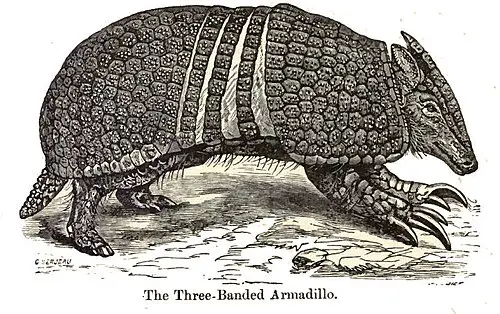
 📸 Photo
Photo: Richard Lydekker · Public domain · Wikimedia Commons Source
Southern Three-banded Armadillo
Tolypeutes matacus (Southern Three-banded Armadillo · マタコミツオビアルマジロ)
💡 Everyday Comparisons for Size, Mass & Speed
- 💡 Its weight of 1.6 kg is slightly heavier than a 1.5 L bottle of water, and its body length of 30 cm is the length of a student ruler (Comparison).
- 💡 It is hunted for its meat throughout its range and serves as an important food source in some regions.
Reference standards: coach bus ~12 m, mid-size car ~4.9 m, compact car ~1 t, basketball hoop 3.05 m, credit card 8.56 cm.
Site-computed relative index from recorded values; not a formal scientific metric.
📖 1. Overview
The Southern Three-banded Armadillo is famous for rolling its body into a complete ball and lives along the edges of grasslands and marshes. Its IUCN assessment is Near Threatened (NT).
🦴 2. Anatomy & Morphology
A thick, leathery shell covers its dark brown body and is usually divided into 3 bands. When closing its shell, it leaves a small gap that snaps shut on a predator's paw or foot, and its tail is stout and inflexible.
🔍 3. Ecology & Behavior
It uses its strong legs and large claws to dig into ant and termite mounds or search under tree bark for food. Rather than digging its own burrows, it uses abandoned anteater burrows or shelters under dense vegetation; females give birth to a single young that becomes independent after about 72 days.
🇰🇷 4. Connection to Korea
No direct record connecting this species to Korea has been found.
📚 Sources & References
- • IUCN Red List NT (2025) — https://www.iucnredlist.org/species/21974/278082690
- • IUCN Red List category NT — latest assessment at iucnredlist.org
- • mammaldiversity.org — 1000419
- • iucnredlist.org — 278082690
- • wikidata.org — Q75070
- • commons.wikimedia.org — File:ThreeBandArmadilloLyd.jpg
- • animaldiversity.org — Tolypeutes matacus
- • Silhouette: PhyloPic — Celeste Luna · CC0 1.0 (Congeneric silhouette — Tolypeutes)
Recorded dimensions are widely cited representative estimates from public literature and may vary by study or specimen.