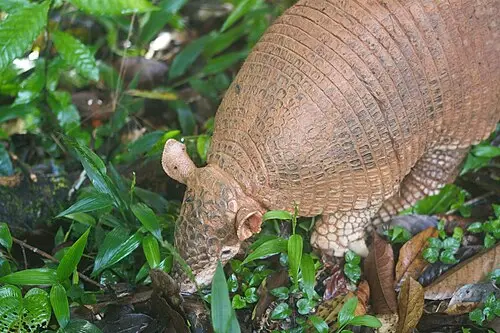
 📸 Photo
Photo: Guillaume Delaitre · CC BY 4.0 · Wikimedia Commons Source
Giant Armadillo
Priodontes maximus (Giant Armadillo · オオアルマジロ)
💡 Everyday Comparisons for Size, Mass & Speed
- 💡 Its average weight of 26.8 kg is about one and a half 20 kg bags of rice, and its length of 96 cm is just shy of a 1 m ruler (Comparison).
- 💡 Before its numbers declined, it helped control leafcutter ants that damage crops, and Indigenous peoples have hunted it for meat.
Reference standards: coach bus ~12 m, mid-size car ~4.9 m, compact car ~1 t, basketball hoop 3.05 m, credit card 8.56 cm.
Site-computed relative index from recorded values; not a formal scientific metric.
📖 1. Overview
The Giant Armadillo is by far the largest of all armadillos and lives in areas rich in termites. It forages alone at night, and its IUCN status is Vulnerable (VU).
🦴 2. Anatomy & Morphology
Its carapace is covered with bony scales, black to gray on top and much paler below. Its enlarged central claw resembles that of the Giant Anteater, and it uses this spade-like claw to dig large burrows.
🔍 3. Ecology & Behavior
It feeds mainly on termites and certain ants, and also eats carrion, worms, and small vertebrates. Balancing on its hind legs and tail, it stands up to tear into tall termite mounds, and it gives birth to one young (occasionally two) at a time.
🇰🇷 4. Connection to Korea
No direct record connecting this species to Korea has been found.
📚 Sources & References
- • IUCN Red List VU (2025) — https://www.iucnredlist.org/species/18144/244101181
- • IUCN Red List category VU — latest assessment at iucnredlist.org
- • mammaldiversity.org — 1000418
- • iucnredlist.org — 244101181
- • wikidata.org — Q755719
- • commons.wikimedia.org — File:Priodontes maximus at Régina.jpg
- • animaldiversity.org — Priodontes maximus
- • Silhouette: PhyloPic — Celeste Luna · CC0 1.0
Recorded dimensions are widely cited representative estimates from public literature and may vary by study or specimen.