 📸 Photo
Photo: Public domain · Public domain · Wikimedia Commons Source
Pink Fairy Armadillo
Chlamyphorus truncatus (Pink Fairy Armadillo · ヒメアルマジロ)
💡 Everyday Comparisons for Size, Mass & Speed
- 💡 Its average weight of 120 g equals the weight of two chicken eggs, and its body length of 13 cm is shorter than a ballpoint pen (Comparison).
- 💡 Local residents reportedly pay little attention to this animal, and neither harms the other.
Reference standards: coach bus ~12 m, mid-size car ~4.9 m, compact car ~1 t, basketball hoop 3.05 m, credit card 8.56 cm.
Site-computed relative index from recorded values; not a formal scientific metric.
📖 1. Overview
The Pink Fairy Armadillo is the smallest living armadillo and a nocturnal burrowing animal that lives in sandy soils. Its IUCN assessment is Data Deficient (DD).
🦴 2. Anatomy & Morphology
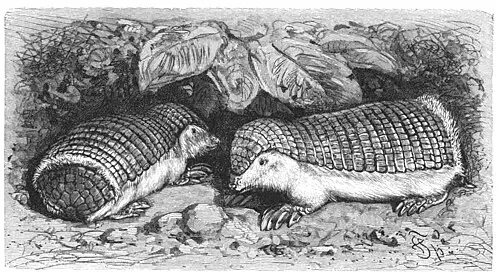
Its carapace is attached to the body only by a thin membrane along the midline of the back, and a large vertical plate shields the rear end. It has no external ears, small eyes, and digging claws on its forelimbs.
🔍 3. Ecology & Behavior
It is known to feed mainly on ants and also eat plant matter when conditions suit. It appears to forage alone at night, and because captured individuals do not drink water, it likely obtains moisture from its food.
🇰🇷 4. Connection to Korea
No direct record connecting this species to Korea has been found.
📚 Sources & References
- • IUCN Red List DD (2025) — https://www.iucnredlist.org/species/4704/244100423
- • IUCN Red List category DD — latest assessment at iucnredlist.org
- • mammaldiversity.org — 1000409
- • iucnredlist.org — 244100423
- • wikidata.org — Q846337
- • commons.wikimedia.org — File:Guertelmaus-drawing.jpg
- • animaldiversity.org — Chlamyphorus truncatus
Recorded dimensions are widely cited representative estimates from public literature and may vary by study or specimen.