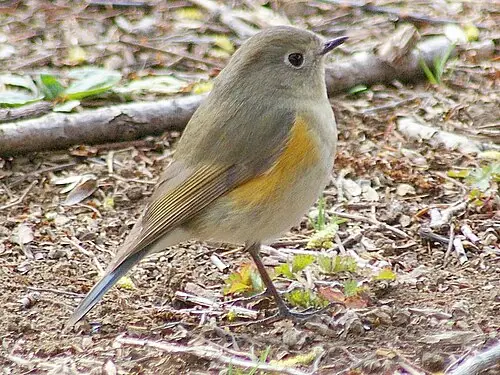
 📸 Photo
Photo: Materialscientist ( talk ) · CC BY-SA 3.0 · Wikimedia Commons Source
Red-flanked Bluetail
Tarsiger cyanurus (Red-flanked Bluetail · ルリビタキ)
💡 Everyday Comparisons for Size, Mass & Speed
- 💡 Its length of 14 cm is equal to the length of a ballpoint pen (about 14 cm) (Comparison).
- 💡 Hong Kong bird records mention an individual visiting an apartment balcony for about 2 weeks to eat mealworms, showing that it sometimes comes close to people for food during winter cold.
Reference standards: coach bus ~12 m, mid-size car ~4.9 m, compact car ~1 t, basketball hoop 3.05 m, credit card 8.56 cm.
📖 1. Overview
The Red-flanked Bluetail is a small bird in the old world flycatcher family, recorded in Hong Kong as a winter visitor in closed-canopy shrublands and forests. In the woods it is shy and inconspicuous, so its presence is often detected by its call.
🦴 2. Anatomy & Morphology
It is a small bird measuring about 13–14 cm in body length.
🔍 3. Ecology & Behavior
It perches on low branches before dropping to the ground to catch invertebrates, and also spends long periods foraging in thickets or the forest understory. During cold spells when food is scarce, it becomes more visible and may approach closer to people.
🇰🇷 4. Connection to Korea
It is listed under the Korean name 'Yuri-ttaksae' (Korean name) in the National List of Species of Korea (without a descriptive text).
📚 Sources & References
- • IUCN Red List LC (2025) — https://www.iucnredlist.org/species/105294257/280967917
- • IUCN Red List category LC — latest assessment at iucnredlist.org
- • doi.org — avilist.v2026
- • iucnredlist.org — 280967917
- • 국가생물종목록(국립생물자원관) ktsn 120000528886 — https://species.nibr.go.kr/home/mainHome.do?cont_link=009&subMenu=009002&contCd=009002&ktsn=120000528886
- • wikidata.org — Q129219
- • commons.wikimedia.org — File:Ruribitakif1.JPG
- • avifauna.hkbws.org.hk — 049600
- • species.nibr.go.kr — mainHome.do
- • Silhouette: PhyloPic — Martin Bulla, based on François Desbordes' illustration · CC BY 4.0 (Related taxon silhouette — Phoenicurus ochruros)
Recorded dimensions are widely cited representative estimates from public literature and may vary by study or specimen.