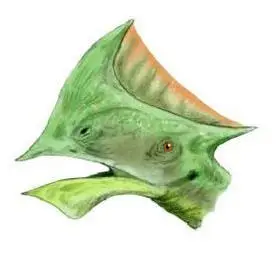
 🎨 Restoration
Restoration: Nobu Tamura ( http://spinops.blogspot.com ) · CC BY-SA 3.0 · Wikimedia Commons Source
Life restorations are artistic reconstructions based on fossil evidence; true coloration and soft-tissue details remain uncertain.
Tapejara
Tapejara wellnhoferi (Tapejara · Tapejara)
Known only from fossils. The IUCN Red List assesses only species extant since 1500 CE, so fossil taxa are not assigned a category.
💡 Everyday Comparisons for Size, Mass & Speed
- 💡 The estimated wingspan of about 1.23–1.3 m for the juveniles buried together is roughly the height of an elementary school student (Comparison).
- 💡 The key finding of the paper is that two juveniles and part of a skull were preserved together inside a single rock concretion.
Reference standards: coach bus ~12 m, mid-size car ~4.9 m, compact car ~1 t, basketball hoop 3.05 m, credit card 8.56 cm.
📖 1. Overview
Tapejara wellnhoferi (genus Tapejara) was a pterosaur that lived in northeastern Brazil during the Early Cretaceous. Two juveniles and part of a skull were found together inside a single stone nodule.
🦴 2. Anatomy & Morphology
Its humerus had pneumatic openings on both the upper and lower sides, and air sacs extended into the hindlimbs through the femur. Reconstructions of the brain from the cranial cavity show enlarged regions for balance and vision.
🔍 3. Fossil Record & Paleoecology
The two juveniles buried together are estimated to have had wingspans of about 1.23–1.3 m. As the first case of multiple individuals preserved together, it allowed detailed comparisons of the anatomy of Tapejara.
🇰🇷 4. Connection to Korea
No direct record connecting this species to Korea has been found.
📚 Sources & References
- • Fossil taxon — the IUCN Red List assesses only species living or extinct since 1500
- • paleobiodb.org — basicTaxonInfo
- • wikidata.org — Q118274195
- • commons.wikimedia.org — File:Tapejara wellnoferi.jpg
- • sjpp.springeropen.com — s13358-011-0024-5
- • Silhouette: PhyloPic — Jaime Headden · CC BY 3.0
Recorded dimensions are widely cited representative estimates from public literature and may vary by study or specimen.