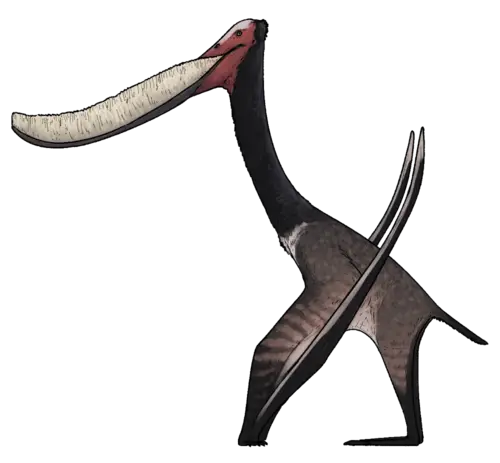
 🎨 Restoration
Restoration: Connor Ashbridge · CC BY 4.0 · Wikimedia Commons Source
Life restorations are artistic reconstructions based on fossil evidence; true coloration and soft-tissue details remain uncertain.
Pterodaustro
Pterodaustro guinazui (Pterodaustro · Pterodaustro)
Known only from fossils. The IUCN Red List assesses only species extant since 1500 CE, so fossil taxa are not assigned a category.
💡 Everyday Comparisons for Size, Mass & Speed
- 💡 The 2.5 m wingspan of the largest individuals is wider than the height of a standard doorway (about 2 m) (Comparison).
- 💡 Its filter-feeding habit brings to mind flamingos seen at zoos or along watersides today (Comparison).
Reference standards: coach bus ~12 m, mid-size car ~4.9 m, compact car ~1 t, basketball hoop 3.05 m, credit card 8.56 cm.
📖 1. Overview
Pterodaustro guinazui (genus Pterodaustro) was a distinctive filter-feeding pterosaur that lived along lakeshores in central Argentina during the Early Cretaceous. Fossils of hundreds of individuals, from embryos inside eggs to large adults, have been found.
🦴 2. Anatomy & Morphology
Individuals ranging in wingspan from 0.3 m to 2.5 m are known. Hatchlings grew rapidly for about 2 years until reaching roughly 53% of adult size, and then grew slowly afterward.
🔍 3. Fossil Record & Paleoecology
It is introduced as a filter-feeding pterosaur that strained food from the water. Once it reached full adult size, its growth stopped.
🇰🇷 4. Connection to Korea
No direct record connecting this species to Korea has been found.
📚 Sources & References
- • Fossil taxon — the IUCN Red List assesses only species living or extinct since 1500
- • paleobiodb.org — basicTaxonInfo
- • wikidata.org — Q124488393
- • commons.wikimedia.org — File:Pterodaustro.jpg
- • pmc.ncbi.nlm.nih.gov — PMC2610039
- • Silhouette: PhyloPic — Cy Marchant · CC BY 4.0
Recorded dimensions are widely cited representative estimates from public literature and may vary by study or specimen.