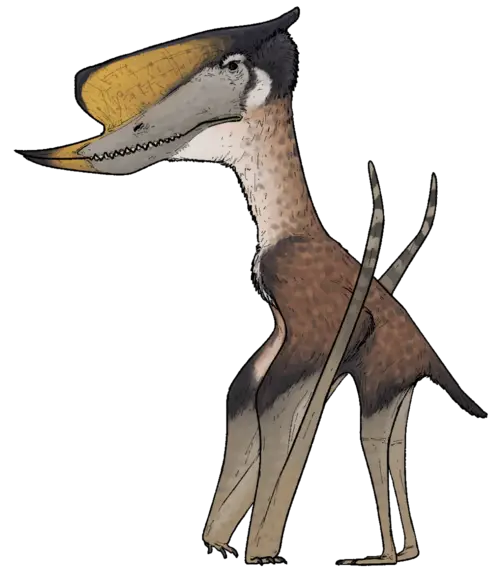
 🎨 Restoration
Restoration: Connor Ashbridge · CC BY 4.0 · Wikimedia Commons Source
Life restorations are artistic reconstructions based on fossil evidence; true coloration and soft-tissue details remain uncertain.
Dsungaripterus
Dsungaripterus weii (Dsungaripterus · Dsungaripterus)
Known only from fossils. The IUCN Red List assesses only species extant since 1500 CE, so fossil taxa are not assigned a category.
💡 Everyday Comparisons for Size, Mass & Speed
- 💡 Its way of picking up shellfish brings to mind modern sandpipers or plovers probing for prey with their beaks on mudflats (Comparison).
- 💡 The function of its inner teeth in cracking hard shells can be compared to cracking walnuts with a nutcracker (Comparison).
Reference standards: coach bus ~12 m, mid-size car ~4.9 m, compact car ~1 t, basketball hoop 3.05 m, credit card 8.56 cm.
📖 1. Overview
Dsungaripterus weii (genus Dsungaripterus) is a pterosaur found in the Junggar Basin of Xinjiang, China, with narrow upward-curved jaws and shell-crushing teeth.
🦴 2. Anatomy & Morphology
The tips of its jaws were slender, toothless, and curved upward, while the inner teeth were small, stout, and rounded. The beak portion may have been covered in thick keratin.
🔍 3. Fossil Record & Paleoecology
Along shallow waters or mudflats, it is thought to have picked up clams, snails, and hard-shelled insects with the tips of its jaws and crushed them with its teeth. Yang Zhongjian (Young) named it in 1964, and additional skulls were discovered later.
🇰🇷 4. Connection to Korea
No direct record connecting this species to Korea has been found.
📚 Sources & References
- • Fossil taxon — the IUCN Red List assesses only species living or extinct since 1500
- • paleobiodb.org — basicTaxonInfo
- • wikidata.org — Q21162011
- • commons.wikimedia.org — File:Dsungaripterus weii 01.jpg
- • doi.org — peerj.8741
- • doi.org — brv.12431
- • Silhouette: PhyloPic — Connor Ashbridge · CC BY 4.0
Recorded dimensions are widely cited representative estimates from public literature and may vary by study or specimen.