 📸 Photo
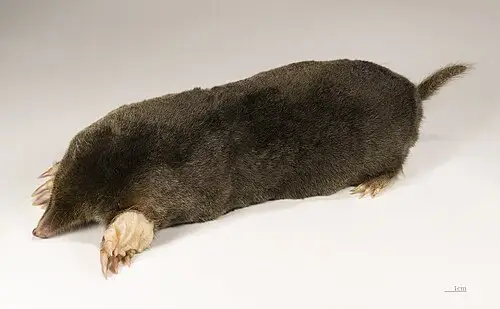
Photo: Didier Descouens · CC BY-SA 4.0 · Wikimedia Commons Source
European Mole
Talpa europaea (European Mole · ヨーロッパモグラ)
💡 Everyday Comparisons for Size, Mass & Speed
- 💡 Its maximum weight of 128 g is similar to two chicken eggs (about 120 g), and its maximum body length of 15.9 cm is similar to the length of a smartphone (about 15 cm) (Comparison).
- 💡 It preys on pest insects and helps aerate and enrich the soil by digging.
Reference standards: coach bus ~12 m, mid-size car ~4.9 m, compact car ~1 t, basketball hoop 3.05 m, credit card 8.56 cm.
Site-computed relative index from recorded values; not a formal scientific metric.
📖 1. Overview
The European Mole spends its entire life underground in the fields, woods, and pastures of Europe. It does poorly in sandy soil or freshly plowed land that is unsuitable for tunneling.
🦴 2. Anatomy & Morphology
Its body is long and cylindrical with velvety black fur. Its small eyes are hidden in the fur, external ears are absent, and its forefeet bear 5 strong outward-turned claws well suited for digging.
🔍 3. Ecology & Behavior
Where earthworms are plentiful it feeds mainly on earthworms, and elsewhere mainly on insects. Its burrow networks can stretch up to half a kilometer, and it hunts at night while solitarily defending its territory.
🇰🇷 4. Connection to Korea
No direct record connecting this species to Korea has been found.
📚 Sources & References
- • IUCN Red List LC (2023) — https://www.iucnredlist.org/species/221751920/221752008
- • IUCN Red List category LC — latest assessment at iucnredlist.org
- • mammaldiversity.org — 1004339
- • iucnredlist.org — 221752008
- • wikidata.org — Q209067
- • commons.wikimedia.org — File:Talpa europaea MHNT.jpg
- • animaldiversity.org — Talpa europaea
- • Silhouette: PhyloPic — Steven Traver · CC0 1.0
Recorded dimensions are widely cited representative estimates from public literature and may vary by study or specimen.