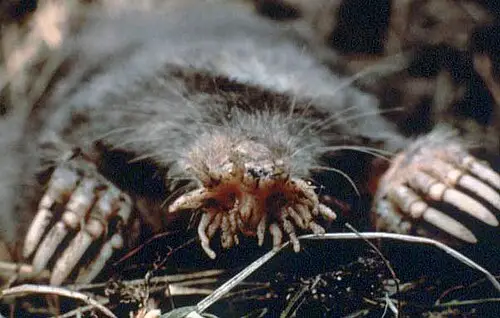
 📸 Photo
Photo: US National Parks Service · Public domain · Wikimedia Commons Source
Star-nosed Mole
Condylura cristata (Star-nosed Mole · ホシバナモグラ)
💡 Everyday Comparisons for Size, Mass & Speed
- 💡 Its maximum weight of 75 g is slightly heavier than a chicken egg (around 60 g), and its maximum total length of 20.5 cm is almost equal to the short side of an A4 sheet of paper (21 cm) (Comparison).
- 💡 It is described as beneficial to humans because it eats pest insect larvae and aerates the soil. The mounds of earth it pushes up (molehills) can reach 60 cm wide and 15 cm high.
Reference standards: coach bus ~12 m, mid-size car ~4.9 m, compact car ~1 t, basketball hoop 3.05 m, credit card 8.56 cm.
Site-computed relative index from recorded values; not a formal scientific metric.
📖 1. Overview
The Star-nosed Mole is a mole living in wet soils and wetlands of North America, best known for the star-shaped appendage at the tip of its nose. It also ventures into water to forage.
🦴 2. Anatomy & Morphology
Around its hairless nose are 22 pink fleshy tentacles arranged in a star shape (11 on each side, 1 to 4 mm long). Its body is plump and cylindrical with sturdy forelimbs and large claws.
🔍 3. Ecology & Behavior
It mainly eats invertebrates such as earthworms, leeches, and aquatic insect larvae. It digs long burrows along the edges of wet ground and gives birth to a litter of 2 to 7 young (usually 5).
🇰🇷 4. Connection to Korea
No direct record connecting this species to Korea has been found.
📚 Sources & References
- • IUCN Red List LC (2016) — https://www.iucnredlist.org/species/41458/115187740
- • IUCN Red List category LC — latest assessment at iucnredlist.org
- • mammaldiversity.org — 1004300
- • iucnredlist.org — 115187740
- • wikidata.org — Q547663
- • commons.wikimedia.org — File:Condylura.jpg
- • animaldiversity.org — Condylura cristata
- • Silhouette: PhyloPic — author not recorded · CC0 1.0 (Related taxon silhouette — Urotrichus talpoides)
Recorded dimensions are widely cited representative estimates from public literature and may vary by study or specimen.