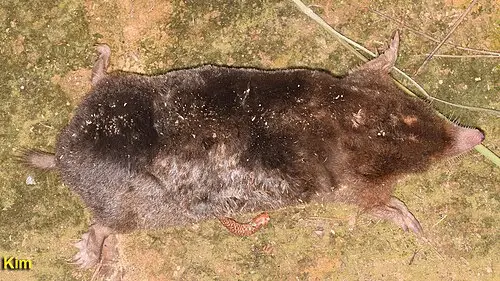
 📸 Photo
Photo: pintail · CC BY 4.0 · Wikimedia Commons Source
Ussuri Mole
Mogera robusta (Ussuri Mole · Ussuri Mole)
💡 Everyday Comparisons for Size, Mass & Speed
- 💡 It lives in the soil of farmland such as rice paddies and dry fields, feeding on earthworms and insect larvae.
- 💡 Its maximum head-and-body length of 16.5 cm is slightly longer than the width of a Korean 1,000-won bill (15.1 cm) (Comparison).
Reference standards: coach bus ~12 m, mid-size car ~4.9 m, compact car ~1 t, basketball hoop 3.05 m, credit card 8.56 cm.
Site-computed relative index from recorded values; not a formal scientific metric.
📖 1. Overview
The Ussuri Mole is a large subterranean mole living in northeastern China, southeastern Primorsky Krai in Russia, and the Korean Peninsula.
🦴 2. Anatomy & Morphology
Its back is brown with a metallic grayish sheen and its belly is silvery yellow. It has a sturdy skull, a broad snout, and 42 teeth in total.
🔍 3. Ecology & Behavior
It feeds on insects and larvae, earthworms, millipedes, and centipedes, and rarely eats snails, spiders, or mice. Breeding from late March to mid-August (months 3–8), it has two litters a year of 2–10 young per litter, and the young nurse for 26–30 days.
🇰🇷 4. Connection to Korea
It is listed on the National List of Species of Korea by the National Institute of Biological Resources (NIBR) and is distributed across the Korean Peninsula. Researchers differ on whether moles on the Korean Peninsula belong to this species or a separate species.
📚 Sources & References
- • IUCN Red List category LC — latest assessment at iucnredlist.org
- • mammaldiversity.org — 1004327
- • iucnredlist.org — 41466
- • 국가생물종목록(국립생물자원관) ktsn 120000209288 — https://species.nibr.go.kr/home/mainHome.do?cont_link=009&subMenu=009002&contCd=009002&ktsn=120000209288
- • wikidata.org — Q2661249
- • commons.wikimedia.org — File:Mogera robusta 2.jpg
- • tb.plazi.org — 0380B547B64CFF9B9FA7F3DAFB96C57F
- • Silhouette: PhyloPic — author not recorded · CC0 1.0 (Related taxon silhouette — Urotrichus talpoides)
Recorded dimensions are widely cited representative estimates from public literature and may vary by study or specimen.