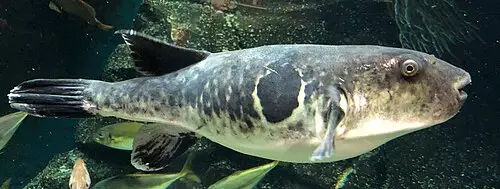
 📸 Photo
Photo: Totti · CC BY-SA 4.0 · Wikimedia Commons Source
Japanese pufferfish
Takifugu rubripes (Japanese pufferfish · トラフグ)
💡 Everyday Comparisons for Size, Mass & Speed
- 💡 Because pufferfish poison is present in the roe and internal organs, Korea's Food and Drug Administration advised in 2010 to eat only pufferfish prepared by licensed professional chefs.
- 💡 FishBase notes that it is a highly prized food fish in Japan.
- 💡 Its maximum weight of 10 kg is about one 10 kg bag of rice, and its maximum length of 80 cm is about 80% of a 1 m ruler (Comparison).
Reference standards: coach bus ~12 m, mid-size car ~4.9 m, compact car ~1 t, basketball hoop 3.05 m, credit card 8.56 cm.
Site-computed relative index from recorded values; not a formal scientific metric.
📖 1. Overview
The Japanese pufferfish is the largest pufferfish in its genus in the northwestern Pacific, growing up to 80 cm.
🦴 2. Anatomy & Morphology
FishBase notes that its liver and ovaries are strongly toxic and its intestines are weakly toxic, while its flesh, skin, and testes are non-toxic.
🔍 3. Ecology & Behavior
It lives in inner bays, and young fish grow in river estuaries before moving out to sea as they mature. From March to May, it spawns at sea, attaching its eggs to gravel and rocks at depths of about 20 m.
🇰🇷 4. Connection to Korea
It is a species occurring in Korea and listed on the National List of Species of Korea as "Jajubok" (Korean name).
📚 Sources & References
- • IUCN Red List NT (2014) — https://www.iucnredlist.org/species/193612/2247747
- • IUCN Red List category NT — latest assessment at iucnredlist.org
- • catalogueoflife.org — 54KQB
- • iucnredlist.org — 2247747
- • 국가생물종목록(국립생물자원관) ktsn 120000059419 — https://species.nibr.go.kr/home/mainHome.do?cont_link=009&subMenu=009002&contCd=009002&ktsn=120000059419
- • wikidata.org — Q1065355
- • commons.wikimedia.org — File:Takifugu rubripes Kamo aquarium2.jpg
- • fishbase.se — Takifugu-rubripes.html
- • pmc.ncbi.nlm.nih.gov — PMC9826526
- • korea.kr — pressReleaseView.do
- • Silhouette: PhyloPic — author not recorded · CC0 1.0
Recorded dimensions are widely cited representative estimates from public literature and may vary by study or specimen.