 📸 Photo
Photo: Chris Spain · CC0 · Wikimedia Commons Source
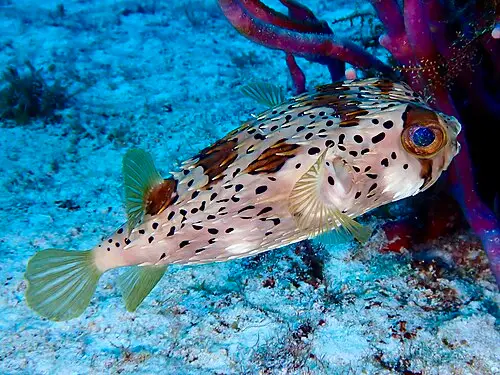
Longspined porcupinefish
Diodon holocanthus (Longspined porcupinefish · ハリセンボン)
💡 Everyday Comparisons for Size, Mass & Speed
- 💡 Its maximum body length of 50 cm is about 1.7 times the long side of an A4 sheet of paper (29.7 cm) (Comparison).
- 💡 Juveniles float near the sea surface until reaching 6–9 cm, which is similar to the long side of a credit card (8.56 cm) (Comparison).
Reference standards: coach bus ~12 m, mid-size car ~4.9 m, compact car ~1 t, basketball hoop 3.05 m, credit card 8.56 cm.
📖 1. Overview
The Longspined porcupinefish is a spiny pufferfish-like fish living on shallow coral reefs in tropical seas worldwide, growing up to 50 cm.
🦴 2. Anatomy & Morphology
Roughly a single row of 14–16 spines runs from the tip of the snout to the front of the dorsal fin, and thick brown bars pass above and below the eyes. Juveniles have distinct spots on the body.
🔍 3. Ecology & Behavior
At night, it preys on mollusks, sea urchins, hermit crabs, and crabs. It is solitary but sometimes forms groups, and juveniles float near the sea surface until they reach 6–9 cm, often staying among clumps of sargassum.
🇰🇷 4. Connection to Korea
It is a species distributed in Korea and listed as Gasibok (Korean name) on the National List of Species of Korea.
📚 Sources & References
- • IUCN Red List LC (2015) — https://www.iucnredlist.org/species/193817/115332473
- • IUCN Red List category LC — latest assessment at iucnredlist.org
- • catalogueoflife.org — 6D7NC
- • iucnredlist.org — 115332473
- • 국가생물종목록(국립생물자원관) ktsn 120000059430 — https://species.nibr.go.kr/home/mainHome.do?cont_link=009&subMenu=009002&contCd=009002&ktsn=120000059430
- • wikidata.org — Q1329475
- • commons.wikimedia.org — File:Diodon holocanthus 430513883.jpg
- • fishbase.se — Diodon-holocanthus.html
- • Silhouette: PhyloPic — author not recorded · CC0 1.0
Recorded dimensions are widely cited representative estimates from public literature and may vary by study or specimen.