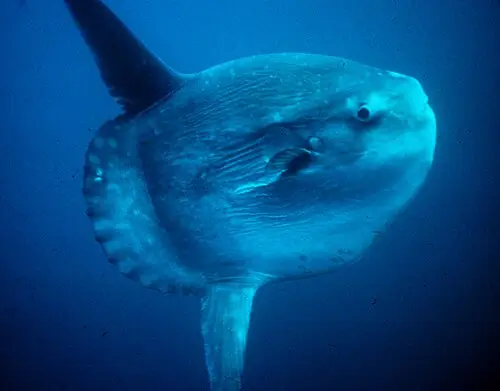
 📸 Photo
Photo: U.S. National Oceanic and Atmospheric Administration · Public domain · Wikimedia Commons Source
Ocean sunfish
Mola mola (Ocean sunfish · マンボウ)
💡 Everyday Comparisons for Size, Mass & Speed
- 💡 Its maximum length of 3.33 m is about 3/4 the length of a passenger car (about 4.5 m), and its maximum weight of 1.3 t is heavier than a compact car (about 1 t) (Comparison).
- 💡 FishBase notes that it feeds on jellyfish.
Reference standards: coach bus ~12 m, mid-size car ~4.9 m, compact car ~1 t, basketball hoop 3.05 m, credit card 8.56 cm.
Site-computed relative index from recorded values; not a formal scientific metric.
📖 1. Overview
The ocean sunfish is a large, roundish, laterally flattened fish living in all tropical and temperate oceans, growing over 3 m long and recorded up to 1.3 t.
🦴 2. Anatomy & Morphology
Its body lacks scales and is covered in very thick, elastic skin, with a rudder-like clavus in place of a caudal fin. Its mouth is small with fused teeth resembling a parrot's beak, and it lacks a swim bladder.
🔍 3. Ecology & Behavior
It swims upright or floats on its side near the surface, feeding on fish, mollusks, zooplankton, jellyfish, crustaceans, and brittle stars. Along deep-sea slopes, it seeks out cleaner fish to have its body cleaned.
🇰🇷 4. Connection to Korea
It is a species distributed in Korea, listed as 'Gaebokchi' (Korean name) on the National List of Species of Korea.
📚 Sources & References
- • IUCN Red List VU (2015) — https://www.iucnredlist.org/species/190422/97667070
- • IUCN Red List category VU — latest assessment at iucnredlist.org
- • catalogueoflife.org — 43V8G
- • iucnredlist.org — 97667070
- • 국가생물종목록(국립생물자원관) ktsn 120000059436 — https://species.nibr.go.kr/home/mainHome.do?cont_link=009&subMenu=009002&contCd=009002&ktsn=120000059436
- • wikidata.org — Q192285
- • commons.wikimedia.org — File:Mola mola.jpg
- • fishbase.se — Mola-mola.html
- • Silhouette: PhyloPic — author not recorded · CC0 1.0
Recorded dimensions are widely cited representative estimates from public literature and may vary by study or specimen.