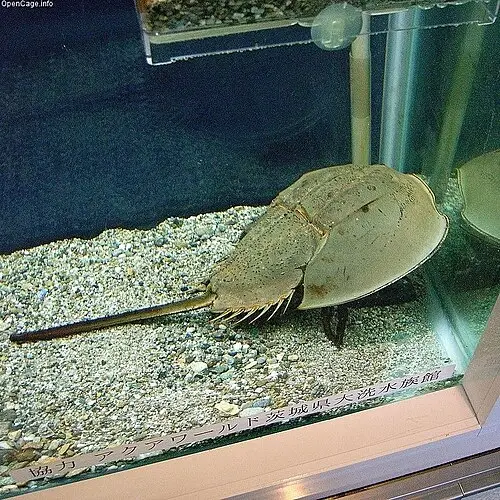
 📸 Photo
Photo: Daiju Azuma · CC BY-SA 2.5 · Wikimedia Commons Source
Tri-spine horseshoe crab
Tachypleus tridentatus (Tri-spine horseshoe crab · カブトガニ)
💡 Everyday Comparisons for Size, Mass & Speed
- 💡 A female's average weight of about 3 kg is similar to a standard 3 kg bag of rice sold in stores (Comparison).
- 💡 Harvesting for pharmaceutical raw materials such as TAL reagent derived from horseshoe crab blood is also cited as a threat in the IUCN assessment.
- 💡 The marine organism database SeaLifeBase indicates that this horseshoe crab is toxic if eaten.
Reference standards: coach bus ~12 m, mid-size car ~4.9 m, compact car ~1 t, basketball hoop 3.05 m, credit card 8.56 cm.
Site-computed relative index from recorded values; not a formal scientific metric.
📖 1. Overview
The tri-spine horseshoe crab is a species of horseshoe crab living along shallow coasts of the western Pacific. Due to the loss of spawning beaches and mudflats where juveniles grow, it was assessed as Endangered (EN, 2019) by the IUCN.
🦴 2. Anatomy & Morphology
Its body is divided into three parts: a dome-shaped prosoma in front, an abdomen with marginal spines in the middle, and a spine-like telson at the rear. Age and growth stage are estimated by the width of the prosoma.
🔍 3. Ecology & Behavior
It lives along sandy and muddy coasts, spawns on sandy beaches at high tide, and juveniles burrow into mudflats at low tide. A study in Hong Kong reported that it takes 13–14 years to reach adulthood.
🇰🇷 4. Connection to Korea
It is listed as 'Segasituguge' (Korean name) in the National List of Species of Korea by the National Institute of Biological Resources (NIBR).
📚 Sources & References
- • IUCN Red List EN (2019) — https://www.iucnredlist.org/species/21309/149768986
- • IUCN Red List category EN — latest assessment at iucnredlist.org
- • marinespecies.org — aphia.php
- • iucnredlist.org — 149768986
- • 국가생물종목록(국립생물자원관) ktsn 120000201179 — https://species.nibr.go.kr/home/mainHome.do?cont_link=009&subMenu=009002&contCd=009002&ktsn=120000201179
- • wikidata.org — Q1328469
- • commons.wikimedia.org — File:Tachypleus tridentatus.jpg
- • sealifebase.se — Tachypleus-tridentatus.html
- • jeeng.net — Using-Applied-Statistics-for-Accurate-Size-Classification-of
- • horseshoecrab.org — IUCN-Red-List Supplemental Combined.pdf
- • Silhouette: PhyloPic — Christoph Schomburg · CC0 1.0 (Related taxon silhouette — Limulus)
Recorded dimensions are widely cited representative estimates from public literature and may vary by study or specimen.