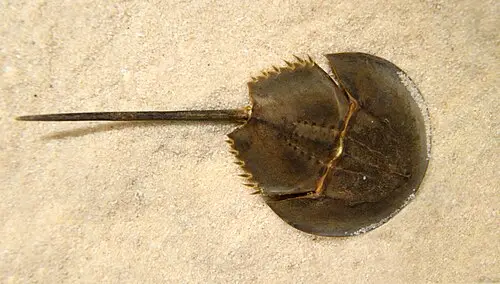
 📸 Photo
Photo: Amada44 · CC BY 3.0 · Wikimedia Commons Source
Mangrove horseshoe crab
Carcinoscorpius rotundicauda (Mangrove horseshoe crab · マルオカブトガニ)
💡 Everyday Comparisons for Size, Mass & Speed
- 💡 Its maximum total length of 40 cm is about a handspan (10 cm) longer than a 30 cm ruler (Comparison).
- 💡 Singapore's National Parks Board (NParks) explains that a specialized serum refined from horseshoe crab blood is used to detect bacterial toxins.
Reference standards: coach bus ~12 m, mid-size car ~4.9 m, compact car ~1 t, basketball hoop 3.05 m, credit card 8.56 cm.
📖 1. Overview
The mangrove horseshoe crab is a horseshoe crab living in mangrove forests in places such as Singapore, where juveniles appear in large numbers seasonally. The IUCN Red List assessed it as Data Deficient (DD) in 1996.
🦴 2. Anatomy & Morphology
Its shell is brown and its tail has a round cross-section. Smaller than Tachypleus gigas, it is said to grow to an average diameter of about 150 mm.
🔍 3. Ecology & Behavior
It lays eggs along the upper margins of mangroves or on calm sand and mud beaches, and juveniles burrow into the mud at low tide. Its eggs are occasionally eaten, though they are known to contain mild poison.
🇰🇷 4. Connection to Korea
No direct record connecting this species to Korea has been found.
📚 Sources & References
- • IUCN Red List DD (1996) — https://www.iucnredlist.org/species/3856/10123044
- • IUCN Red List category DD — latest assessment at iucnredlist.org
- • marinespecies.org — aphia.php
- • iucnredlist.org — 10123044
- • wikidata.org — Q2673503
- • commons.wikimedia.org — File:Carcinoscorpius rotundicauda (mangrove horseshoe crab).
- • sealifebase.se — Carcinoscorpius-rotundicauda.html
- • nparks.gov.sg — 438
- • nparks.gov.sg — 437
- • Silhouette: PhyloPic — author not recorded · CC0 1.0
Recorded dimensions are widely cited representative estimates from public literature and may vary by study or specimen.