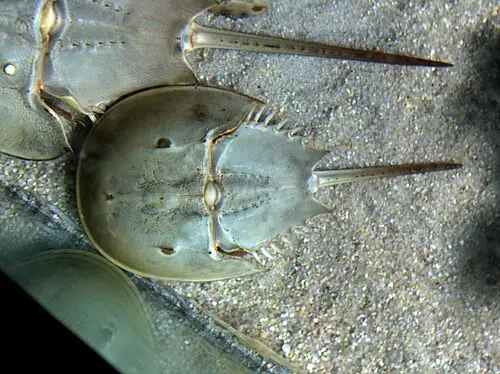
 📸 Photo
Photo: João Carvalho · CC BY-SA 2.5 · Wikimedia Commons Source
Atlantic horseshoe crab
Limulus polyphemus (Atlantic horseshoe crab · アメリカカブトガニ)
💡 Everyday Comparisons for Size, Mass & Speed
- 💡 A maximum total length of 60 cm is similar to two 1.5-liter water bottles (about 30 cm tall) laid end to end, and a maximum weight of 1.8 kg is slightly heavier than one 1.5-liter water bottle (Comparison).
- 💡 Animal Diversity Web explains that studying how this horseshoe crab's central nervous system processes information laid the foundation for understanding information processing in other animals. It frequently appears in textbooks on vision and neuroscience.
Reference standards: coach bus ~12 m, mid-size car ~4.9 m, compact car ~1 t, basketball hoop 3.05 m, credit card 8.56 cm.
Site-computed relative index from recorded values; not a formal scientific metric.
📖 1. Overview
The Atlantic horseshoe crab lives on sandy and muddy bottoms of shallow waters along the Atlantic coast; despite its name, it is closer to arachnids and is called a 'living fossil.' The IUCN Red List assessed it as Vulnerable (VU) in 2016.
🦴 2. Anatomy & Morphology
On the underside of the abdomen are six pairs of flat appendages that function as gills, with the first pair covering the genital pores. Females are much larger than males, with males about 1/3 the size of females.
🔍 3. Ecology & Behavior
At night it feeds on marine worms, small clams, and algae, picking up food with its chelicerae, crushing it between the bristles at the bases of its legs, and passing it to the mouth. It usually walks along the bottom, but can also swim awkwardly upside down using its gill flaps like paddles.
🇰🇷 4. Connection to Korea
No direct record connecting this species to Korea has been found.
📚 Sources & References
- • IUCN Red List VU (2016) — https://www.iucnredlist.org/species/11987/80159830
- • IUCN Red List category VU — latest assessment at iucnredlist.org
- • marinespecies.org — aphia.php
- • iucnredlist.org — 80159830
- • 국가생물종목록(국립생물자원관) ktsn 120000236834 — https://species.nibr.go.kr/home/mainHome.do?cont_link=009&subMenu=009002&contCd=009002&ktsn=120000236834
- • wikidata.org — Q1133152
- • commons.wikimedia.org — File:Animal marinho1813.JPG
- • sealifebase.se — Limulus-polyphemus.html
- • animaldiversity.org — Limulus polyphemus
- • Silhouette: PhyloPic — Andy Wilson · CC0 1.0
Recorded dimensions are widely cited representative estimates from public literature and may vary by study or specimen.