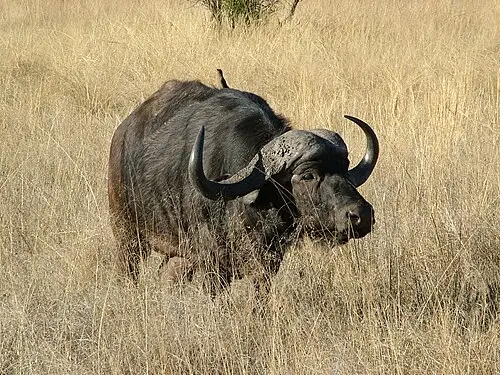
 📸 Photo
Photo: Paul M Rae · CC BY 2.5 · Wikimedia Commons Source
Cape Buffalo
Syncerus caffer (Cape Buffalo · アフリカスイギュウ)
💡 Everyday Comparisons for Size, Mass & Speed
- 💡 An individual weighing over 835 kg equals about 42 bags of 20 kg rice (Comparison).
- 💡 Bringing income to ranches through safari tourism and regulated hunting, private lands with Cape Buffalo can charge up to twice as much as competitors (Animal Diversity Web).
- 💡 Private lands where wildlife lives create ranch jobs through ecotourism and hunting (Animal Diversity Web).
Reference standards: coach bus ~12 m, mid-size car ~4.9 m, compact car ~1 t, basketball hoop 3.05 m, credit card 8.56 cm.
Site-computed relative index from recorded values; not a formal scientific metric.
📖 1. Overview
The Cape Buffalo is a massive bovid that can live almost anywhere from tropical rainforests to semi-arid bushland as long as permanent water and grass are present.
🦴 2. Anatomy & Morphology
It has a stocky build and heavy horns without ridges in both males and females. Above its rounded hooves sit dewclaws.
🔍 3. Ecology & Behavior
It spends most of its time grazing on grass and chewing the cud. Herds range from a few individuals to over a thousand, and in the Serengeti they can average more than 1500 animals.
🇰🇷 4. Connection to Korea
No direct record connecting this species to Korea has been found.
📚 Sources & References
- • IUCN Red List NT (2019) — https://www.iucnredlist.org/species/21251/50195031
- • IUCN Red List category NT — latest assessment at iucnredlist.org
- • mammaldiversity.org — 1006274
- • iucnredlist.org — 50195031
- • wikidata.org — Q160042
- • commons.wikimedia.org — File:African Buffalo.JPG
- • animaldiversity.org — Syncerus caffer
- • Silhouette: PhyloPic — An Ignorant Atheist · CC0 1.0
Recorded dimensions are widely cited representative estimates from public literature and may vary by study or specimen.