 📸 Photo
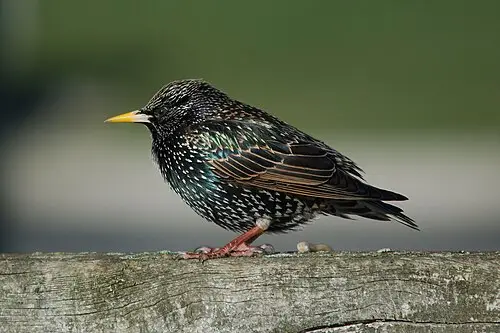
Photo: marsupium photography · CC BY-SA 2.0 · Wikimedia Commons Source
Common Starling
Sturnus vulgaris (Common Starling · ホシムクドリ)
💡 Everyday Comparisons for Size, Mass & Speed
- 💡 Its weight of 70–100 g is about the weight of one and a half chicken eggs (Comparison).
- 💡 According to ADW, it helps reduce insect pests that damage farm crops and is also used as food in some Mediterranean cultures.
Reference standards: coach bus ~12 m, mid-size car ~4.9 m, compact car ~1 t, basketball hoop 3.05 m, credit card 8.56 cm.
Site-computed relative index from recorded values; not a formal scientific metric.
📖 1. Overview
The Common Starling is a starling with glossy iridescent green plumage whose feather tips wear down in winter to produce white spots on the breast. It lives in flocks and nests in holes in trees and buildings.
🦴 2. Anatomy & Morphology
Both sexes have glossy green feathers covering the back, nape, and breast, with black wings. The bill is black for most of the year and turns yellow in the breeding season, while the legs are reddish-brown.
🔍 3. Ecology & Behavior
It readily eats seeds, insects, earthworms, spiders, and fruits, inserting its bill into food and prying it open to reach tough-shelled prey. In Europe, breeding is reported to proceed in three distinct phases, with a clutch laid in each phase.
🇰🇷 4. Connection to Korea
The National List of Species of Korea records it as a vagrant bird observed in places such as Cheonsuman Bay, Haenam, and Jeju Island.
📚 Sources & References
- • IUCN Red List LC (2019) — https://www.iucnredlist.org/species/22710886/137493608
- • IUCN Red List category LC — latest assessment at iucnredlist.org
- • doi.org — avilist.v2026
- • iucnredlist.org — 137493608
- • 국가생물종목록(국립생물자원관) ktsn 120000002087 — https://species.nibr.go.kr/home/mainHome.do?cont_link=009&subMenu=009002&contCd=009002&ktsn=120000002087
- • wikidata.org — Q25469
- • commons.wikimedia.org — File:Common Starling, Blyth (12598795653).jpg
- • animaldiversity.org — Sturnus vulgaris
- • species.nibr.go.kr — mainHome.do
- • Silhouette: PhyloPic — Maxime Dahirel · CC BY 3.0
Recorded dimensions are widely cited representative estimates from public literature and may vary by study or specimen.