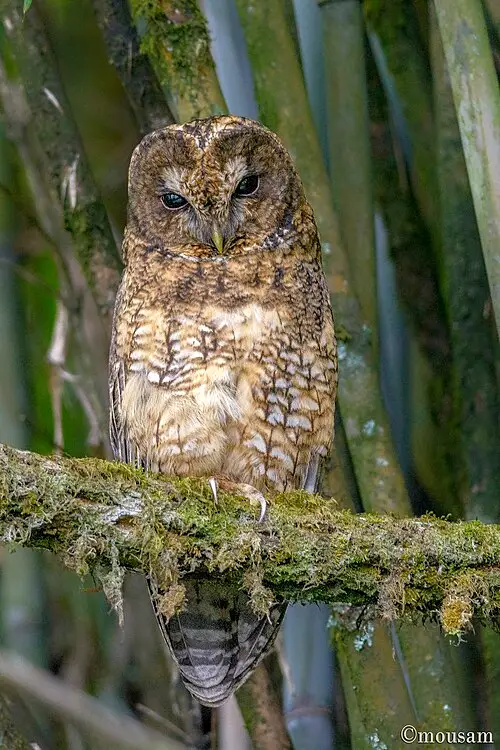
 📸 Photo
Photo: Mousam ray · CC BY-SA 4.0 · Wikimedia Commons Source
Himalayan Owl
Strix nivicolum (Himalayan Owl · Himalayan Owl)
🇰🇷 Class II endangered wildlife (Korea) · Natural Monument (Korea) «Himalayan Owl»
💡 Everyday Comparisons for Size, Mass & Speed
- 💡 It also lives close to people in places such as parks, cemeteries, and large gardens.
- 💡 Its weight of 0.52 kg is close to the weight of 9 chicken eggs (taking 1 egg as 60 g, Comparison).
- 💡 It also uses artificial nest boxes put up by people as nesting sites.
Reference standards: coach bus ~12 m, mid-size car ~4.9 m, compact car ~1 t, basketball hoop 3.05 m, credit card 8.56 cm.
Site-computed relative index from recorded values; not a formal scientific metric.
📖 1. Overview
The Himalayan Owl is a medium-sized owl with a round face and no ear tufts, and in Korea it is an uncommon tree-dwelling resident bird. Because Strix nivicolum was split from the European Strix aluco, many sources still list it under the older name.
🦴 2. Anatomy & Morphology
Its head is large and round without ear tufts, and its dark eyes face forward. Its ears are placed asymmetrically on the left and right, allowing it to pinpoint the direction of sounds.
🔍 3. Ecology & Behavior
It feeds mainly on rodents such as wood mice along with amphibians, birds, and beetles, and eats more birds in cities. It uses tree hollows, old nests of other birds, buildings, or nest boxes, laying usually 2–3 eggs.
🇰🇷 4. Connection to Korea
In Korea, it was designated as a Natural Monument (Korea) on November 16, 1982, and is an uncommon resident bird that sits motionless on tree branches by day and becomes active at night.
📚 Sources & References
- • IUCN Red List LC (2024) — https://www.iucnredlist.org/species/22725477/264106602
- • 멸종위기 야생생물 Ⅱ급 · 천연기념물 «올빼미» — 국가생물종목록(국립생물자원관) ktsn 120000001861 — https://species.nibr.go.kr/home/mainHome.do?cont_link=009&subMenu=009002&contCd=009002&ktsn=120000001861
- • IUCN Red List category LC — latest assessment at iucnredlist.org
- • Korean protection status: Class II endangered wildlife (Korea) · Natural Monument (Korea) «Himalayan Owl»
- • doi.org — avilist.v2026
- • iucnredlist.org — 264106602
- • 국가생물종목록(국립생물자원관) ktsn 120000001861 — https://species.nibr.go.kr/home/mainHome.do?cont_link=009&subMenu=009002&contCd=009002&ktsn=120000001861
- • heritage.go.kr — culSelectDetail.do
- • wikidata.org — Q1237607
- • commons.wikimedia.org — File:Himalayan Wood Owl.jpg
- • animaldiversity.org — Strix aluco
- • Silhouette: PhyloPic — Sharon Wegner-Larsen · CC0 1.0 (Congeneric silhouette — Tyto alba)
Recorded dimensions are widely cited representative estimates from public literature and may vary by study or specimen.