 📸 Photo
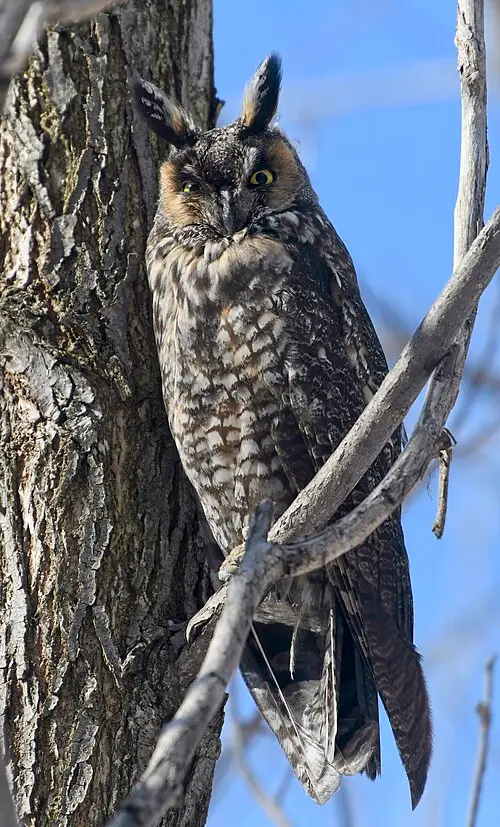
Photo: Mykola Swarnyk · CC BY-SA 3.0 · Wikimedia Commons Source
Long-eared Owl
Asio otus (Long-eared Owl · トラフズク)
🇰🇷 Natural Monument (Korea) «Long-eared Owl»
💡 Everyday Comparisons for Size, Mass & Speed
- 💡 It preys mainly on field mice and voles in croplands and meadows.
- 💡 Its weight of 0.435 kg is just over 7 eggs (assuming 60 g per egg; 1 egg = 60 g).
Reference standards: coach bus ~12 m, mid-size car ~4.9 m, compact car ~1 t, basketball hoop 3.05 m, credit card 8.56 cm.
Site-computed relative index from recorded values; not a formal scientific metric.
📖 1. Overview
The Long-eared Owl is a medium-sized owl of Northern Hemisphere grasslands and forest edges, distinguished by long ear tufts on top of the head.
🦴 2. Anatomy & Morphology
It has a slender body, long wings and tail, and long, blackish ear tufts. Its greyish-brown plumage is vertically streaked, making a perched bird resemble a tree branch.
🔍 3. Ecology & Behavior
It feeds mainly on voles and other small rodents, also taking small birds, snakes, and insects. It uses stick nests built by other birds and lays 2–10 eggs (usually 5–6).
🇰🇷 4. Connection to Korea
In Korea, it was designated as a Natural Monument on November 16, 1982; active at night, it preys on voles, shrews, and small birds.
📚 Sources & References
- • IUCN Red List LC (2021) — https://www.iucnredlist.org/species/22689507/201150685
- • 천연기념물 «칡부엉이» — 국가생물종목록(국립생물자원관) ktsn 120000001870 — https://species.nibr.go.kr/home/mainHome.do?cont_link=009&subMenu=009002&contCd=009002&ktsn=120000001870
- • IUCN Red List category LC — latest assessment at iucnredlist.org
- • Korean protection status: Natural Monument (Korea) «Long-eared Owl»
- • doi.org — avilist.v2026
- • iucnredlist.org — 201150685
- • 국가생물종목록(국립생물자원관) ktsn 120000001870 — https://species.nibr.go.kr/home/mainHome.do?cont_link=009&subMenu=009002&contCd=009002&ktsn=120000001870
- • heritage.go.kr — culSelectDetail.do
- • wikidata.org — Q25384
- • commons.wikimedia.org — File:Asio otus Downsview Park Toronto2.jpg
- • animaldiversity.org — Asio otus
- • Silhouette: PhyloPic — hedera.baltica · CC BY 4.0
Recorded dimensions are widely cited representative estimates from public literature and may vary by study or specimen.