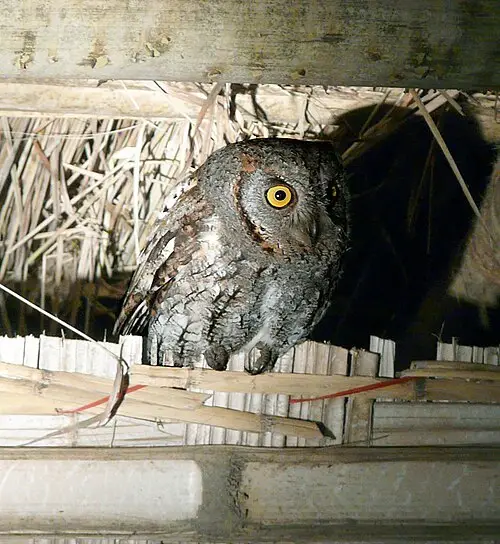
 📸 Photo
Photo: gailhampshire from Cradley, Malvern, U.K · CC BY 2.0 · Wikimedia Commons Source
Oriental Scops Owl
Otus sunia (Oriental Scops Owl · コノハズク)
🇰🇷 Natural Monument (Korea) «Oriental Scops Owl»
💡 Everyday Comparisons for Size, Mass & Speed
- 💡 Its body length of 20 cm is similar to the height of a 500 mL plastic bottle (about 20 cm) (Comparison).
- 💡 During the May–June breeding season, its all-night calls can be heard from village hills, parks, and near temples.
Reference standards: coach bus ~12 m, mid-size car ~4.9 m, compact car ~1 t, basketball hoop 3.05 m, credit card 8.56 cm.
📖 1. Overview
The Oriental Scops Owl is a very small owl living widely across Asia and is a migratory bird that comes to Korea to breed in summer.
🦴 2. Anatomy & Morphology
At about 20 cm in body length, it is smaller than the Japanese Scops Owl (about 24 cm) or the Tawny Owl (about 35 cm) recorded by the Korea Heritage Service.
🔍 3. Ecology & Behavior
It rests in forests during the day and is active at night, eating mainly insects and spiders while also catching small birds and mice. During the May–June breeding season, it calls all night and lays 3–4 white eggs in a tree hollow.
🇰🇷 4. Connection to Korea
In Korea, it was designated as a Natural Monument (Korea) on November 16, 1982, and is a summer visitor breeding nationwide.
📚 Sources & References
- • IUCN Red List LC (2021) — https://www.iucnredlist.org/species/22728969/206482277
- • 천연기념물 «소쩍새» — 국가생물종목록(국립생물자원관) ktsn 120000001855 — https://species.nibr.go.kr/home/mainHome.do?cont_link=009&subMenu=009002&contCd=009002&ktsn=120000001855
- • IUCN Red List category LC — latest assessment at iucnredlist.org
- • Korean protection status: Natural Monument (Korea) «Oriental Scops Owl»
- • doi.org — avilist.v2026
- • iucnredlist.org — 206482277
- • 국가생물종목록(국립생물자원관) ktsn 120000001855 — https://species.nibr.go.kr/home/mainHome.do?cont_link=009&subMenu=009002&contCd=009002&ktsn=120000001855
- • heritage.go.kr — culSelectDetail.do
- • wikidata.org — Q1260390
- • commons.wikimedia.org — File:Oriental Scops Owl Otus sunia, Suklaphanta, Nepal.jpg
- • species.nibr.go.kr — mainHome.do
- • Silhouette: PhyloPic — Rachel T Mason · CC0 1.0 (Related taxon silhouette — Ninox strenua)
Recorded dimensions are widely cited representative estimates from public literature and may vary by study or specimen.