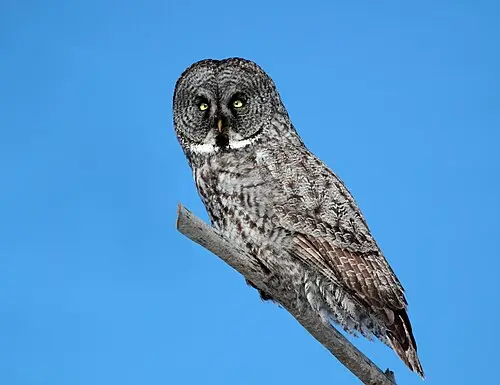
 📸 Photo
Photo: Cephas · CC BY-SA 3.0 · Wikimedia Commons Source
Great Grey Owl
Strix nebulosa (Great Grey Owl · カラフトフクロウ)
💡 Everyday Comparisons for Size, Mass & Speed
- 💡 Its maximum weight of 1.454 kg is similar to a 1.5 L bottle of water, and its wingspan of about 1.5 m is about the width of an adult's outstretched arms (Comparison).
- 💡 It helps clear carrion and keep rodent numbers in check, and as a rare sight, it draws birdwatchers from many places (ADW 'Economic Importance for Humans: Positive').
- 💡 Some Alaska Indigenous peoples also use this bird as a food source in winter because of its rich stored fat (ADW).
Reference standards: coach bus ~12 m, mid-size car ~4.9 m, compact car ~1 t, basketball hoop 3.05 m, credit card 8.56 cm.
Site-computed relative index from recorded values; not a formal scientific metric.
📖 1. Overview
The Great Grey Owl is a large owl living in northern coniferous forests and is the tallest owl in Alaska. It is characterized by a round head without ear tufts and a gray body.
🦴 2. Anatomy & Morphology
Its round, tuftless head has a distinct facial disk marked with gray concentric circles, and its bill and eyes are yellow. The facial feathers direct sound toward its ear openings, while an asymmetrical skull and large ear openings let it pinpoint sounds accurately.
🔍 3. Ecology & Behavior
Small rodents such as voles and pocket gophers make up 80–90% of its diet, and it can locate rodents by sound even about 60 cm beneath the snow and plunge in to catch them. It hunts well by day or night and lays 2–5 eggs in nests abandoned by raptors or crows.
🇰🇷 4. Connection to Korea
No direct record connecting this species to Korea has been found.
📚 Sources & References
- • IUCN Red List LC (2021) — https://www.iucnredlist.org/species/22689118/199144259
- • IUCN Red List category LC — latest assessment at iucnredlist.org
- • doi.org — avilist.v2026
- • iucnredlist.org — 199144259
- • wikidata.org — Q200724
- • commons.wikimedia.org — File:Strix nebulosa CT.jpg
- • animaldiversity.org — Strix nebulosa
- • Silhouette: PhyloPic — author not recorded · Public Domain Mark 1.0 (Congeneric silhouette — Tyto alba furcata)
Recorded dimensions are widely cited representative estimates from public literature and may vary by study or specimen.