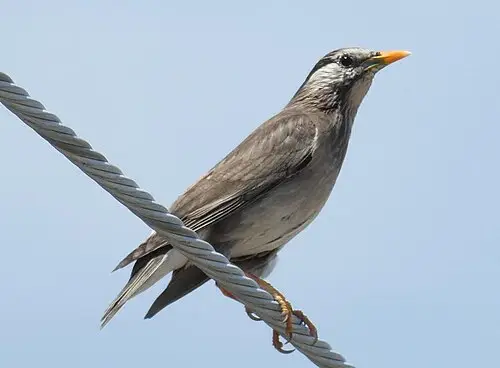
 📸 Photo
Photo: 切干大根 · CC BY-SA 4.0 · Wikimedia Commons Source
White-cheeked Starling
Spodiopsar cineraceus (White-cheeked Starling · ムクドリ)
💡 Everyday Comparisons for Size, Mass & Speed
- 💡 Its body length of 24 cm is slightly longer than the short side of an A4 sheet of paper (21 cm) (Comparison).
- 💡 According to the National List of Species of Korea, it also nests in building roofs, crevices, and stone wall gaps, so it can be seen close to buildings in cities and villages.
Reference standards: coach bus ~12 m, mid-size car ~4.9 m, compact car ~1 t, basketball hoop 3.05 m, credit card 8.56 cm.
📖 1. Overview
The White-cheeked Starling is a bird in the starling family (order Passeriformes) that breeds across Korea as a common summer visitor and also stays through winter in central and southern regions. Outside the breeding season, it usually lives in flocks.
🦴 2. Anatomy & Morphology
Its body length is about 24 cm. In winter plumage, the male's head and nape are black with a greenish gloss, the feathers on the head and throat are shaped like willow leaves, the iris is brown, and the legs are yellow.
🔍 3. Ecology & Behavior
It lays 4–6 eggs between late March and July in tree holes, building roofs or crevices, stone wall gaps, or old woodpecker nests. It has an omnivorous diet.
🇰🇷 4. Connection to Korea
The National List of Species of Korea records it as a common summer visitor breeding throughout Korea and a winter visitor that also overwinters in central and southern Korea.
📚 Sources & References
- • IUCN Red List LC (2024) — https://www.iucnredlist.org/species/22710896/263935242
- • IUCN Red List category LC — latest assessment at iucnredlist.org
- • doi.org — avilist.v2026
- • iucnredlist.org — 263935242
- • 국가생물종목록(국립생물자원관) ktsn 120000002086 — https://species.nibr.go.kr/home/mainHome.do?cont_link=009&subMenu=009002&contCd=009002&ktsn=120000002086
- • wikidata.org — Q27075595
- • commons.wikimedia.org — File:Spodiopsar cineraceus Higashi-hagoromo station.jpg
- • species.nibr.go.kr — mainHome.do
- • Silhouette: PhyloPic — Maxime Dahirel · CC BY 3.0 (Related taxon silhouette — Sturnus vulgaris)
Recorded dimensions are widely cited representative estimates from public literature and may vary by study or specimen.