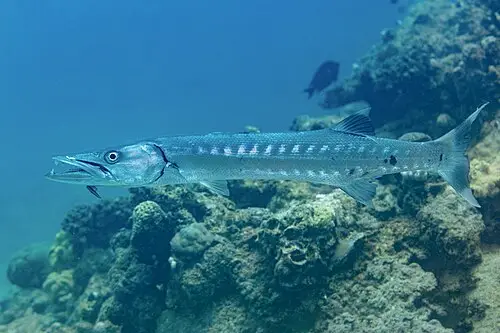
 📸 Photo
Photo: Diego Delso · CC BY-SA 4.0 · Wikimedia Commons Source
Great barracuda
Sphyraena barracuda (Great barracuda · オニカマス)
💡 Everyday Comparisons for Size, Mass & Speed
- 💡 Its maximum length of 2 m is close to half the length of a passenger car (about 4.5 m) (Comparison).
- 💡 Some people find its meat tasty, and it is prized as a hard-fighting game fish on light tackle (Animal Diversity Web).
- 💡 Caution is needed when eating it because it can carry ciguatoxin in many parts of its range, although toxicity has not been reported in the eastern Atlantic (FishBase).
Reference standards: coach bus ~12 m, mid-size car ~4.9 m, compact car ~1 t, basketball hoop 3.05 m, credit card 8.56 cm.
Site-computed relative index from recorded values; not a formal scientific metric.
📖 1. Overview
The great barracuda is an elongated, silvery carnivorous fish living along coral reef edges and in shallow seas. Juveniles grow up in mangroves and estuaries.
🦴 2. Anatomy & Morphology
It has a long silvery body with two widely separated dorsal fins, and a pointed head with a large mouth and long, knife-like teeth. The lower jaw juts out, the back is grayish-brown, and the belly is silvery.
🔍 3. Ecology & Behavior
It feeds on fish throughout its life, hunting through a combination of ambush and active pursuit. Adults are mostly solitary though sometimes school during the day, and their eggs are left to drift without parental care.
🇰🇷 4. Connection to Korea
No direct record connecting this species to Korea has been found.
📚 Sources & References
- • IUCN Red List LC (2015) — https://www.iucnredlist.org/species/190399/115319634
- • IUCN Red List category LC — latest assessment at iucnredlist.org
- • catalogueoflife.org — 4Z2L3
- • iucnredlist.org — 115319634
- • wikidata.org — Q2306485
- • commons.wikimedia.org — File:Gran barracuda (Sphyraena barracuda), Yeda, Arabia Saud
- • fishbase.se — Sphyraena-barracuda.html
- • animaldiversity.org — Sphyraena barracuda
- • Silhouette: PhyloPic — Rosenthal Harry · CC BY 4.0
Recorded dimensions are widely cited representative estimates from public literature and may vary by study or specimen.