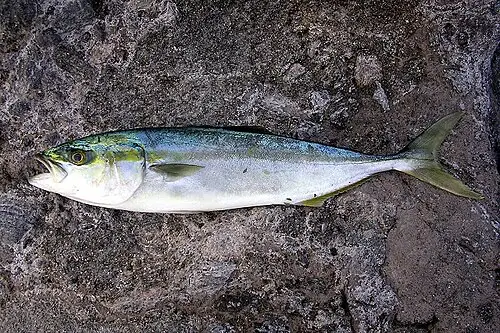
 📸 Photo
Photo: E-190's · CC BY-SA 3.0 · Wikimedia Commons Source
Japanese amberjack
Seriola quinqueradiata (Japanese amberjack · ブリ)
💡 Everyday Comparisons for Size, Mass & Speed
- 💡 Korea Policy Briefing (2025) introduces the Japanese amberjack as gaining flesh and rich fat as the weather turns colder, making it tastiest in winter.
- 💡 FishBase notes that farming by catching and raising young fish thrives in Japan and that it is sold raw as sashimi.
- 💡 Its maximum length of 150 cm is slightly shorter than an adult human's height (about 1.7 m) (Comparison).
Reference standards: coach bus ~12 m, mid-size car ~4.9 m, compact car ~1 t, basketball hoop 3.05 m, credit card 8.56 cm.
Site-computed relative index from recorded values; not a formal scientific metric.
📖 1. Overview
The Japanese amberjack is a large marine fish living from Japan and the eastern seas of the Korean Peninsula to Hawaii, with adults swimming in schools.
🦴 2. Anatomy & Morphology
It is known to reach a maximum total length of 150 cm and a maximum weight of 40 kg.
🔍 3. Ecology & Behavior
Adults are recorded as schooling and feeding on plankton, while young fish grow among drifting mats of seaweed.
🇰🇷 4. Connection to Korea
It is listed on the National List of Species of Korea (National Institute of Biological Resources (NIBR)), and the National Institute of Fisheries Science reported that East Sea catches have risen enough for this species to rank 1st at 21.6% of set-net catches in Goseong, Gangwon-do.
📚 Sources & References
- • IUCN Red List LC (2016) — https://www.iucnredlist.org/species/20435860/115383171
- • IUCN Red List category LC — latest assessment at iucnredlist.org
- • catalogueoflife.org — 6YJC3
- • iucnredlist.org — 115383171
- • 국가생물종목록(국립생물자원관) ktsn 120000058489 — https://species.nibr.go.kr/home/mainHome.do?cont_link=009&subMenu=009002&contCd=009002&ktsn=120000058489
- • wikidata.org — Q1202973
- • commons.wikimedia.org — File:Seriola quinqueradiata (200810).jpg
- • fishbase.se — Seriola-quinqueradiata.html
- • species.nibr.go.kr — general-search
- • korea.kr — healthView.do
- • nifs.go.kr — actionNewsView.do
- • Silhouette: PhyloPic — Lily Hughes · CC0 1.0 (Congeneric silhouette — Seriola rivoliana)
Recorded dimensions are widely cited representative estimates from public literature and may vary by study or specimen.