 📸 Photo
Photo: Christian Ursilva from København, Danmark · CC BY-SA 4.0 · Wikimedia Commons Source
Humboldt Penguin
Spheniscus humboldti (Humboldt Penguin · フンボルトペンギン)
💡 Everyday Comparisons for Size, Mass & Speed
- 💡 Its maximum weight of 5 kg is equal to one 5 kg bag of rice (Comparison).
- 💡 Its accumulated droppings, known as guano, make rich fertilizer and were a major source of income for the Peruvian government (Animal Diversity Web).
- 💡 Starting in 2010, regulations were established to support breeding while maintaining tourism, and ecotourism centered on this penguin began (Animal Diversity Web).
Reference standards: coach bus ~12 m, mid-size car ~4.9 m, compact car ~1 t, basketball hoop 3.05 m, credit card 8.56 cm.
Site-computed relative index from recorded values; not a formal scientific metric.
📖 1. Overview
The Humboldt Penguin is a medium-sized penguin living along the rocky Pacific coast of South America. It spends most of its time in coastal waters.
🦴 2. Anatomy & Morphology
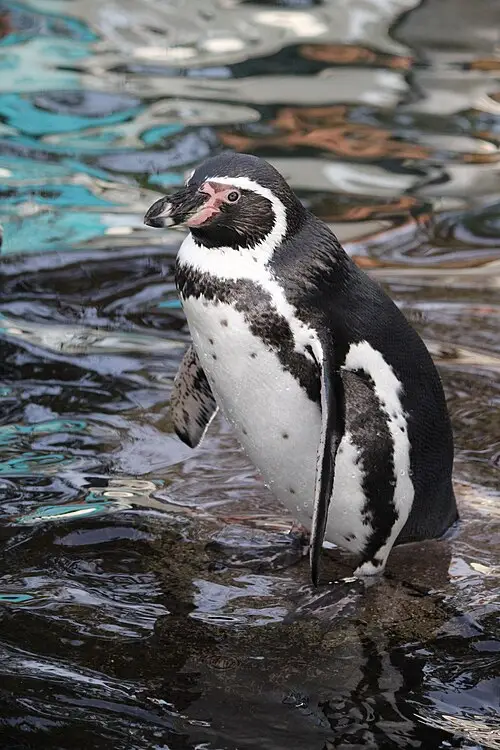
Its back is blackish-gray and its chest is white, with a white stripe on the head wrapping below the eyes to form a horseshoe shape at the chin. A thick black breast band distinguishes it from the Magellanic Penguin (Spheniscus magellanicus).
🔍 3. Ecology & Behavior
Its diet varies by region, feeding on garfish and herring-like fishes in northern Chile and anchovies, sardines, and squid in central Chile. It is monogamous, recognizes its mate by voice, and suffers lower breeding success in areas heavily visited by people.
🇰🇷 4. Connection to Korea
No direct record connecting this species to Korea has been found.
📚 Sources & References
- • IUCN Red List VU (2020) — https://www.iucnredlist.org/species/22697817/182714418
- • IUCN Red List category VU — latest assessment at iucnredlist.org
- • doi.org — avilist.v2026
- • iucnredlist.org — 182714418
- • wikidata.org — Q224151
- • commons.wikimedia.org — File:Spheniscus humboldti (54905367722).jpg
- • animaldiversity.org — Spheniscus humboldti
- • Silhouette: PhyloPic — Andy Wilson · CC0 1.0
Recorded dimensions are widely cited representative estimates from public literature and may vary by study or specimen.