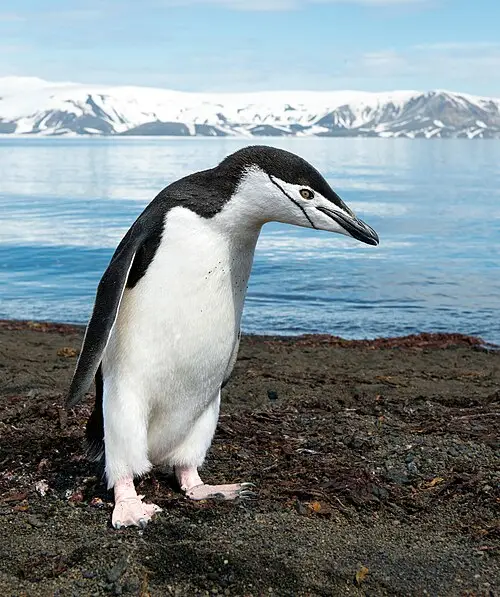
 📸 Photo
Photo: Christopher Michel · CC BY 2.0 · Wikimedia Commons Source
Chinstrap Penguin
Pygoscelis antarcticus (Chinstrap Penguin · ヒゲペンギン)
💡 Everyday Comparisons for Size, Mass & Speed
- 💡 Its standing height of 72 cm is similar to the height of a standard desk (about 70–75 cm) (Comparison).
- 💡 In South America and South Africa, penguin guano is used as fertilizer, making penguins economically important (Animal Diversity Web).
- 💡 On islands in the southern Indian Ocean, fishermen in some places still use penguin meat as bait (Animal Diversity Web).
Reference standards: coach bus ~12 m, mid-size car ~4.9 m, compact car ~1 t, basketball hoop 3.05 m, credit card 8.56 cm.
Site-computed relative index from recorded values; not a formal scientific metric.
📖 1. Overview
The Chinstrap Penguin is a penguin with a thin black band running under its chin. It lives in large colonies on icebergs, with a single colony sometimes reaching millions of birds.
🦴 2. Anatomy & Morphology
Its front and throat are white and its back is black, with a thin black band running from below the reddish eyes to unite under the chin. Chicks have a gray back and white front.
🔍 3. Ecology & Behavior
About 95% of its diet is krill, with the rest consisting of small fish and crustaceans. It builds a circular stone nest and usually lays two eggs, which both parents take turns incubating in shifts of 5–10 days.
🇰🇷 4. Connection to Korea
No direct record connecting this species to Korea has been found.
📚 Sources & References
- • IUCN Red List LC (2020) — https://www.iucnredlist.org/species/22697761/184807209
- • IUCN Red List category LC — latest assessment at iucnredlist.org
- • doi.org — avilist.v2026
- • iucnredlist.org — 184807209
- • wikidata.org — Q126643
- • commons.wikimedia.org — File:A chinstrap penguin (Pygoscelis antarcticus) on Decepti
- • animaldiversity.org — Pygoscelis antarcticus
- • Silhouette: PhyloPic — Edwin Price · CC BY 4.0
Recorded dimensions are widely cited representative estimates from public literature and may vary by study or specimen.