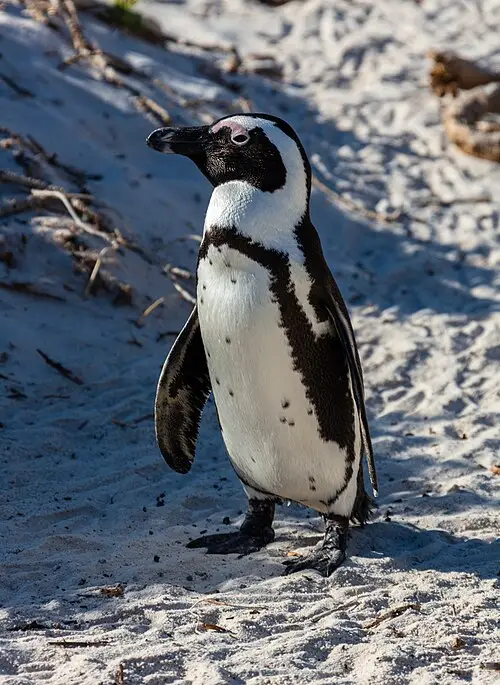
 📸 Photo
Photo: Diego Delso · CC BY-SA 4.0 · Wikimedia Commons Source
African Penguin
Spheniscus demersus (African Penguin · ケープペンギン)
💡 Everyday Comparisons for Size, Mass & Speed
- 💡 The False Bay colony in Simon's Town, South Africa, holds more than 2,000 penguins and is a major tourist spot where people can watch them up close (ADW).
- 💡 Because its size and temperature needs are easy to accommodate, it is the penguin most commonly seen in zoos (ADW).
- 💡 Its average weight of 3.1 kg is similar to two 1.5 L bottles of water (about 3 kg) (Comparison).
Reference standards: coach bus ~12 m, mid-size car ~4.9 m, compact car ~1 t, basketball hoop 3.05 m, credit card 8.56 cm.
Site-computed relative index from recorded values; not a formal scientific metric.
📖 1. Overview
The African Penguin is the only penguin living on the African continent, forming large colonies along the rocky coasts of southwestern Africa. Because of its loud, donkey-like braying call, it is also called the 'jackass penguin.'
🦴 2. Anatomy & Morphology
Its back is black and its chest and belly are white with black markings, while a horseshoe-shaped white band runs from around the eyes toward the bill. Its black-and-white countershading makes it less visible to predators from both above and below.
🔍 3. Ecology & Behavior
It feeds mainly on schooling fish such as anchovies, sardines, and horse mackerel, and also eats squid and crustaceans. It digs a shallow burrow under rocks or in sand, lays 2 eggs, and both parents incubate them for about 40 days.
🇰🇷 4. Connection to Korea
No direct record connecting this species to Korea has been found.
📚 Sources & References
- • IUCN Red List CR (2024) — https://www.iucnredlist.org/species/22697810/256021744
- • IUCN Red List category CR — latest assessment at iucnredlist.org
- • doi.org — avilist.v2026
- • iucnredlist.org — 256021744
- • wikidata.org — Q244813
- • commons.wikimedia.org — File:Pingüino de El Cabo (Spheniscus demersus), Playa de Bou
- • animaldiversity.org — Spheniscus demersus
- • Silhouette: PhyloPic — Andy Wilson · CC0 1.0
Recorded dimensions are widely cited representative estimates from public literature and may vary by study or specimen.