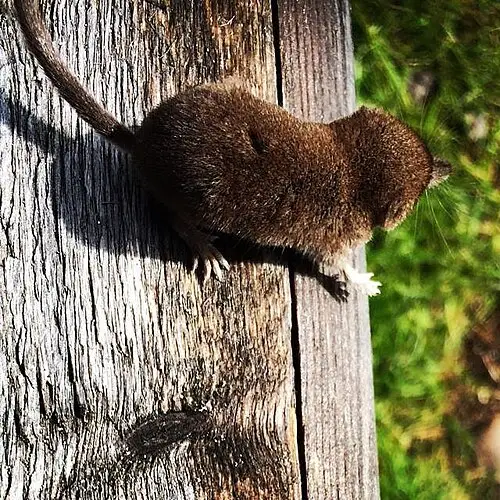
 📸 Photo
Photo: Deryni · CC BY-SA 3.0 · Wikimedia Commons Source
Laxmann's Shrew
Sorex caecutiens (Laxmann's Shrew · バイカルトガリネズミ)
💡 Everyday Comparisons for Size, Mass & Speed
- 💡 Its maximum body length of 7.8 cm is about 3 times the diameter of a Korean 500-won coin (about 2.65 cm) (Comparison).
- 💡 Living in forests, grasslands, and leaf-covered ground across Korea, it feeds on insects, spiders, and centipedes, and outside the breeding season each individual holds its own exclusive territory.
Reference standards: coach bus ~12 m, mid-size car ~4.9 m, compact car ~1 t, basketball hoop 3.05 m, credit card 8.56 cm.
📖 1. Overview
Laxmann's Shrew is a tiny mouse-like mammal of the family Soricidae found nationwide in Korea. It ranges widely from grasslands to forests and is most abundant in woodland habitats.
🦴 2. Anatomy & Morphology
Its head-and-body length is 48–78 mm and its tail length is 39–52 mm. The summer coat is dark reddish brown on the back and gray or pale brown on the belly, while the winter coat is darker.
🔍 3. Ecology & Behavior
It prefers habitats with thick leaf litter and rich humus soil, foraging on the ground mainly for insects, spiders, and centipedes. It breeds mainly in spring, producing 4–8 young per litter, and lives just over 1 year.
🇰🇷 4. Connection to Korea
It is listed as "Dwijwi" (Korean name) on the National List of Species of Korea and occurs nationwide in Korea.
📚 Sources & References
- • IUCN Red List LC (2016) — https://www.iucnredlist.org/species/29662/22314809
- • IUCN Red List category LC — latest assessment at iucnredlist.org
- • mammaldiversity.org — 1004224
- • iucnredlist.org — 22314809
- • 국가생물종목록(국립생물자원관) ktsn 120000053240 — https://species.nibr.go.kr/home/mainHome.do?cont_link=009&subMenu=009002&contCd=009002&ktsn=120000053240
- • wikidata.org — Q873603
- • commons.wikimedia.org — File:Lappnäbbmus 140621.jpg
- • species.nibr.go.kr — mainHome.do
- • Silhouette: PhyloPic — author not recorded · CC0 1.0 (Congeneric silhouette — Sorex araneus)
Recorded dimensions are widely cited representative estimates from public literature and may vary by study or specimen.