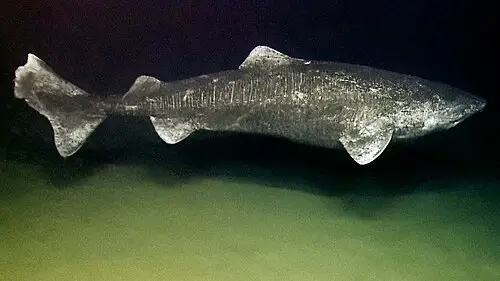
 📸 Photo
Photo: NOAA Okeanos Explorer Program · Public domain · Wikimedia Commons Source
Greenland shark
Somniosus microcephalus (Greenland shark · ニシオンデンザメ)
💡 Everyday Comparisons for Size, Mass & Speed
- 💡 Its maximum length of 5.5 m is about 1 m longer than a passenger car (about 4.5 m) (Comparison).
- 💡 Its maximum weight of 1,000 kg is similar to the weight of a compact car (Comparison).
- 💡 In Arctic regions such as Norway, Iceland, and Greenland, it is caught for its liver oil and meat, and Inuit people have used its skin to make boots and its teeth to make knives (Animal Diversity Web).
Reference standards: coach bus ~12 m, mid-size car ~4.9 m, compact car ~1 t, basketball hoop 3.05 m, credit card 8.56 cm.
Site-computed relative index from recorded values; not a formal scientific metric.
📖 1. Overview
The Greenland shark is a large, sluggish shark living in the cold waters of the Arctic and North Atlantic and has been reported as the longest-living vertebrate, with a lifespan estimated at up to 392 years.
🦴 2. Anatomy & Morphology
Its body is thick and cylindrical with a short, rounded snout and small fins. Its two dorsal fins are equal in size and spineless, and it has no anal fin. Its skin is rough and its body color ranges from gray to brown.
🔍 3. Ecology & Behavior
It feeds on fish such as herring, salmon, cod, halibut, and skates, as well as seals, small dolphins, and carrion. In winter it enters shallow bays and river mouths, and in warmer seasons it moves down to depths of 180–550 m.
🇰🇷 4. Connection to Korea
No direct record connecting this species to Korea has been found.
📚 Sources & References
- • IUCN Red List VU (2020) — https://www.iucnredlist.org/species/60213/124452872
- • IUCN Red List category VU — latest assessment at iucnredlist.org
- • catalogueoflife.org — 4Y8YJ
- • iucnredlist.org — 124452872
- • wikidata.org — Q370444
- • commons.wikimedia.org — File:Somniosus microcephalus okeanos.jpg
- • fishbase.se — Somniosus-microcephalus.html
- • animaldiversity.org — Somniosus microcephalus
- • Silhouette: PhyloPic — Margot Michaud · CC0 1.0
Recorded dimensions are widely cited representative estimates from public literature and may vary by study or specimen.