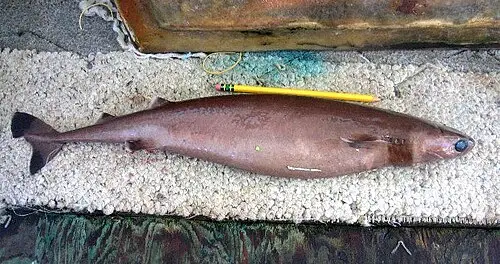
 📸 Photo
Photo: NOAA Observer Project · Public domain · Wikimedia Commons Source
Cookie cutter shark
Isistius brasiliensis (Cookie cutter shark · ダルマザメ)
💡 Everyday Comparisons for Size, Mass & Speed
- 💡 Its maximum length of 56 cm is about twice the long side of an A4 sheet of paper (29.7 cm) (Comparison).
- 💡 Its English name “cookie cutter shark” comes from the round, cookie-cutter-like craters it leaves on the bodies of its prey (Animal Diversity Web).
- 💡 It is known as a facultative ectoparasitic shark that feeds by attaching to large animals such as wahoo, tunas, billfishes, and cetaceans (FishBase).
Reference standards: coach bus ~12 m, mid-size car ~4.9 m, compact car ~1 t, basketball hoop 3.05 m, credit card 8.56 cm.
📖 1. Overview
The cookie cutter shark is a small shark living in deep tropical oceanic waters that gouges round plugs of flesh from larger animals—the habit behind its English name “cookie cutter shark.”
🦴 2. Anatomy & Morphology
Its body is slender and cigar-shaped with a short snout and no anal fin. It has suctorial lips, 25 to 32 rows of large triangular teeth in the lower jaw, and a dark collar around the throat. Its belly is capable of glowing with green bioluminescence.
🔍 3. Ecology & Behavior
It latches onto prey with its suction-like mouth, twists its body, and scoops out a round plug of flesh with its lower teeth. It targets squid, crustaceans, large bony fishes, cetaceans, and even large sharks. It makes daily vertical migrations covering depths of 2,000 to 3,000 m or more.
🇰🇷 4. Connection to Korea
No direct record connecting this species to Korea has been found.
📚 Sources & References
- • IUCN Red List LC (2018) — https://www.iucnredlist.org/species/41830/2956761
- • IUCN Red List category LC — latest assessment at iucnredlist.org
- • catalogueoflife.org — 3Q78H
- • iucnredlist.org — 2956761
- • wikidata.org — Q199372
- • commons.wikimedia.org — File:Isistius brasiliensis.jpg
- • fishbase.se — Isistius-brasiliensis.html
- • animaldiversity.org — Isistius brasiliensis
- • Silhouette: PhyloPic — Ignacio Contreras · CC BY 3.0
Recorded dimensions are widely cited representative estimates from public literature and may vary by study or specimen.