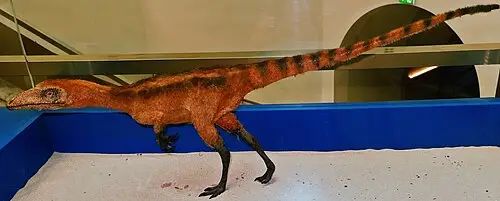
 🎨 Restoration
Restoration: Ghedoghedo · CC BY-SA 4.0 · Wikimedia Commons Source
Life restorations are artistic reconstructions based on fossil evidence; true coloration and soft-tissue details remain uncertain.
Sinosauropteryx
Sinosauropteryx prima (Sinosauropteryx · Sinosauropteryx)
Known only from fossils. The IUCN Red List assesses only species extant since 1500 CE, so fossil taxa are not assigned a category.
💡 Everyday Comparisons for Size, Mass & Speed
- 💡 Its estimated body length of about 1.1 m (representative value for the genus) is slightly longer than an umbrella (about 1 m) (Comparison).
- 💡 As the first case in which a dinosaur's color pattern was determined, it is thought to have had a reddish-brown body and a striped tail.
Reference standards: coach bus ~12 m, mid-size car ~4.9 m, compact car ~1 t, basketball hoop 3.05 m, credit card 8.56 cm.
📖 1. Overview
Sinosauropteryx prima (genus Sinosauropteryx) was a small carnivorous theropod (compsognathid group) that lived in northern China during the Early Cretaceous, and its name means 'Chinese lizard wing.' It was the first non-avian dinosaur confirmed to have feathers.
🦴 2. Anatomy & Morphology
Its body was covered in simple, hair-like protofeathers. It is reconstructed with a reddish-brown body, a banded tail, and a lighter-colored belly.
🔍 3. Fossil Record & Paleoecology
It ate small animals such as mammals and lizards, and one specimen preserves a small lizard in its stomach. In 1996, Li Yumin found the first fossil and sold it to a Chinese museum.
🇰🇷 4. Connection to Korea
No direct record connecting this species to Korea has been found.
📚 Sources & References
- • Fossil taxon — the IUCN Red List assesses only species living or extinct since 1500
- • paleobiodb.org — basicTaxonInfo
- • wikidata.org — Q124605109
- • commons.wikimedia.org — File:Sinosauropteryxfossil.jpg
- • nhm.ac.uk — sinosauropteryx.html
- • Silhouette: PhyloPic — Scott Hartman · CC BY 3.0
Recorded dimensions are widely cited representative estimates from public literature and may vary by study or specimen.